





A Deceptive Shimmer
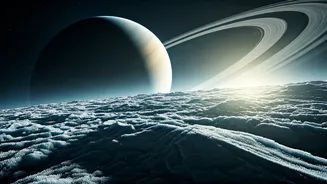
The image of Saturn is one of the most iconic in our solar system, largely thanks to its majestic rings. For centuries, astronomers could only guess at their nature. Today, thanks to missions like Voyager and Cassini, we know they are not solid discs.
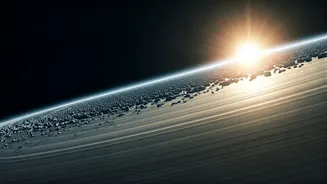
Instead, they are an enormous collection of particles, overwhelmingly composed of water ice—as much as 99.9% pure. A tiny fraction is made of rocky material and dust, likely from micrometeoroid pollution. These particles are incredibly bright and reflective, which is why the rings appear so brilliant even from Earth. They stretch out up to 282,000 kilometres from the planet but are astonishingly thin, with a typical thickness of only about 10 metres in the main rings. It's a structure wider than 20 Earths lined up, yet in most places, you could probably jump over it.
From Dust Grains to Mountains
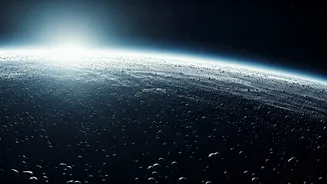
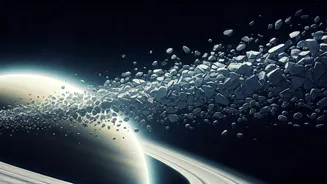
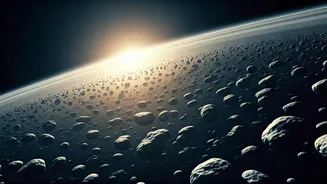
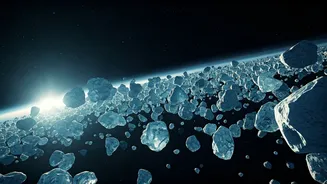
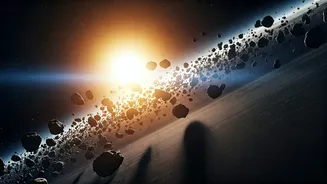
When we say 'billions of ice chunks,' the scale can be hard to grasp. The particles that make up the rings vary dramatically in size. The smallest are like grains of fine dust, too small to see. Others are the size of pebbles or hailstones. A significant number are larger, ranging from the size of a cricket ball to a car. The biggest, though much rarer, can be true behemoths—ice boulders as large as a house or even a small mountain, several kilometres across. These chunks are not floating peacefully. They are all orbiting Saturn at tremendous speeds, moving at tens of thousands of kilometres per hour. This constant, high-speed dance is what maintains the ring structure, a delicate balance of gravity and orbital mechanics.
A Cosmic Crime Scene
One of the biggest mysteries about Saturn's rings is their origin. For a long time, scientists thought they were ancient, formed at the same time as Saturn itself from the primordial disc of gas and dust. However, data from NASA's Cassini mission has challenged this view. The rings are surprisingly 'clean,' with very little dust contamination. If they were billions of years old, they should have been darkened by constant bombardment from micrometeoroids. This has led to a newer, more dramatic theory: the rings are relatively young, perhaps only 10 to 100 million years old. They may have formed when one of Saturn's icy moons strayed too close to the planet and was ripped apart by its immense gravitational pull. Another possibility is that two moons collided, shattering into the countless icy fragments we see today. In this sense, the rings might be the beautiful remnants of a violent cosmic event.
The Shepherd Moons
The rings aren't a single, uniform sheet. They are divided into distinct bands and gaps, some of which are visible even with a good telescope from Earth, like the famous Cassini Division. What keeps them so organised? The answer lies with some of Saturn's 146 known moons. Dozens of small 'shepherd moons' orbit within or just outside the rings. Their gravitational influence is like that of a sheepdog herding a flock. They nudge particles back into line, maintain the sharp edges of the rings, and carve out the gaps between them. Moons like Pan and Daphnis literally plough through the ring material, creating graceful waves and ripples in their wake. This intricate gravitational dance between the moons and the ring particles is responsible for the stunningly complex structure we observe.
A Disappearing Act
As mesmerising as they are, Saturn's rings are not permanent. The Cassini spacecraft made a startling discovery during its final orbits: the rings are raining down on Saturn. Pulled by the planet's gravity and magnetic field, a constant shower of icy particles is being drawn from the rings and into Saturn's upper atmosphere. This phenomenon, dubbed 'ring rain,' is draining the rings of mass at a significant rate. Scientists have calculated that, based on the current rate of decay, the rings have less than 100 million years left before they disappear completely. While that sounds like a long time to us, it's a fleeting moment in cosmic terms. We happen to be living in a special era, able to witness the magnificent rings of Saturn in their prime, a sight that future inhabitants of the solar system may miss entirely.