
More Than Just a Cosmic Eye
Located about 650 light-years away in the constellation Aquarius, the Helix Nebula is one of the most famous and closest planetary nebulae to Earth. For amateur and professional astronomers alike, it has long been a favorite subject, appearing as a ghostly,
ring-like structure. This object represents the final, dramatic life stage of a star similar to our own sun. After exhausting its primary fuel, the star shed its outer layers of gas and dust into space. At the nebula's heart lies the searingly hot core of that original star, now a white dwarf, which illuminates the expanding shells of gas, causing them to glow. For years, telescopes like Hubble showed an ethereal, almost peaceful scene. Webb’s new infrared view, however, changes that picture entirely.
A New Look Through Webb's Infrared Vision
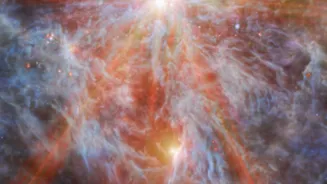
The James Webb Space Telescope's Near-Infrared Camera (NIRCam) has provided the clearest and most detailed look at the nebula to date. Its high-resolution images cut through the gentle glow to reveal the intricate, fine structures within. The new view highlights thousands of previously unseen, comet-like knots and filaments, particularly along the inner edge of the nebula's ring. These aren't just random clumps; they are evidence of a dynamic, ongoing collision. Webb’s imagery shows the stark transition from the hottest gases, closest to the central star, to the coolest molecular gases farther out. This unprecedented detail allows scientists to see not just a static relic, but an active process of cosmic recycling in action, revealing how a dying star returns its material to the galaxy.
The 'Violent' Winds Unleashed
The headline's "violent stellar winds" refer to the powerful outflows from the dying star at the nebula's center. Think of it as a two-act process. First, as the star entered its red giant phase, it slowly puffed its outer layers into space, forming vast, slow-moving shells of gas and dust. Then, the star's core became a hot, dense white dwarf, which began blasting out a new, much faster stream of particles — a stellar wind moving at incredible speeds. The new Webb images vividly show the result: these blistering, high-speed winds are crashing into the older, colder, and slower-moving material. This collision sculpts the nebula, creating the stunning, comet-shaped pillars and intricate structures that Webb has now brought into focus. It's a turbulent, high-energy environment where different layers of ejected material slam into each other, shaping the nebula we see today.
A Glimpse into Our Sun's Distant Future
Studying the Helix Nebula isn't just about admiring a beautiful object; it’s like looking into a crystal ball for our own solar system. Our Sun is a similar type of star, and in about five billion years, it is expected to undergo a similar end-of-life transformation. It will swell into a red giant, shed its outer layers, and leave behind a white dwarf surrounded by its own planetary nebula. By watching the Helix Nebula, astronomers are witnessing the processes that will one day break down our own star and recycle its components—the very elements that make up our planets and ourselves—back into the galaxy. These new observations of how stellar debris is broken apart and mixed into interstellar space provide a crucial, long-sought-after look at the final step in this cosmic cycle. Webb’s findings help us understand how the raw materials for new stars, and perhaps new life, are seeded throughout the universe.