







India's Unblinking Eye on the Sun
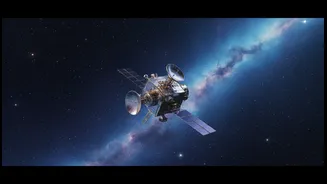
Launched in September 2023, the Aditya-L1 mission is a testament to the Indian Space Research Organisation's (ISRO) growing capabilities. The spacecraft is strategically positioned at the first Lagrange point (L1), about 1.5 million kilometres from Earth.
This unique spot gives it a continuous, uninterrupted view of the Sun, free from eclipses or other obstructions. The mission's primary goal is to study solar phenomena like coronal mass ejections (CMEs), solar flares, and the solar wind that constantly streams towards Earth. Armed with seven sophisticated instruments, Aditya-L1 is designed to observe the Sun's various layers, from the visible surface (photosphere) to its outermost atmosphere (corona).
A Breakthrough X-ray Discovery
In a significant achievement, Aditya-L1 has captured a rare X-ray phenomenon that provides a new window into the origin of powerful solar flares. The spacecraft’s Solar Low Energy X-ray Spectrometer (SoLEXS) observed what is known as photospheric iron fluorescence. This happens when high-energy X-rays from a solar flare travel back towards the Sun's surface, striking neutral iron atoms. These atoms then emit their own X-rays at a characteristic energy. While this effect was predicted, Aditya-L1 conducted the first-ever comprehensive analysis of it during 47 of the most powerful X-class solar flares in 2024. This data, published in the journal Solar Physics, allows scientists to better understand the geometry and height of these massive eruptions.
Unlocking the Secrets of Solar Flares
The mission has also provided groundbreaking views of solar flares in the near-ultraviolet (NUV) spectrum, a range that has been historically difficult to observe in detail. One of the spacecraft’s key instruments, the Solar Ultraviolet Imaging Telescope (SUIT), captured stunning images of an X-class flare, the most intense category, revealing its 'kernel' in the Sun's lower atmosphere. These observations are crucial because they show how energy from a flare spreads through different layers of the Sun’s atmosphere. This was a perspective other solar observatories were effectively blind to, providing a more complete picture of how these violent events unfold.
A Global Leader in Space Weather
Aditya-L1's continuous observations are especially critical as the Sun approaches its solar maximum, a period of peak activity in its 11-year cycle expected in 2026. During this time, the frequency of solar storms and CMEs, which can disrupt satellites, power grids, and communication systems on Earth, is expected to increase significantly. By studying these events, the mission aims to improve space weather forecasting, helping to protect our planet's vital technological infrastructure. The mission has also been part of international collaborations, joining forces with NASA satellites to study extreme solar storms from multiple vantage points, demonstrating India's growing leadership role in global space science.