







A New Cosmic Neighbour
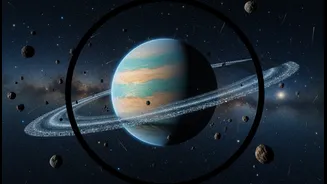
Astronomers recently confirmed new details about an exoplanet named GJ 3378b, located a mere 25 light-years away in the constellation Camelopardalis. That might sound far, but in galactic terms, it's practically next door. This planet is classified as a 'super-Earth,'
weighing in at about 2.3 times the mass of our own world. It orbits its star, a cool red dwarf named Gliese 3378, every 21.45 days. The most exciting part for scientists is that the planet receives about 90% of the radiation from its star that Earth gets from the Sun, placing it in a very interesting orbital position.
The 'Goldilocks Zone' Explained
You've likely heard the term 'habitable zone' or 'Goldilocks zone'. This refers to the orbital region around a star where conditions are not too hot and not too cold, allowing for liquid water to potentially exist on a planet's surface. GJ 3378b sits squarely within its star's habitable zone. This is a critical first checkmark in the search for life-bearing worlds, as all life that we know of depends on liquid water. But finding a planet in this zone is like finding a house in the right neighbourhood; it tells you nothing about whether the house itself is liveable. It's the starting point for investigation, not the conclusion.
More Than Just the Right Temperature
For a planet to be truly habitable, it needs much more than just the right temperature. A stable atmosphere is perhaps the most critical ingredient. Without one, any surface water would boil away into space, and the planet would be bombarded with harsh stellar radiation. One of the biggest unanswered questions about GJ 3378b is whether it has managed to hold onto an atmosphere. Its host star is a red dwarf, which can be volatile and strip atmospheres from nearby planets. Scientists also consider factors like planetary mass (to ensure gravity is strong enough to hold an atmosphere), composition (is it rocky like Earth?), and whether the planet has a magnetic field to deflect solar winds.
The Hunt for Biosignatures
So if 'habitable zone' isn't proof of life, what are scientists looking for? The next major step is to search for 'biosignatures'. These are gases in a planet's atmosphere that could indicate biological processes. On Earth, for example, the high concentration of oxygen is a direct result of life, specifically photosynthesis. Methane is another gas that can be produced by microbes. Using powerful tools like the James Webb Space Telescope (JWST), astronomers can analyse the light that passes through an exoplanet's atmosphere. This allows them to detect the chemical composition and see if gases like oxygen, methane, or others are present. Finding them wouldn't be definitive proof of life—volcanoes and other geological processes can also produce these gases—but it would be an incredibly compelling reason for a closer look.
Why This Discovery Still Matters
Even with all these caveats, the excitement around GJ 3378b is entirely justified. Finding a rocky, Earth-sized planet in the habitable zone of a nearby star is a significant achievement. Each discovery like this helps astronomers refine their models and narrow down the search. It provides a prime target for future observation with advanced instruments like the JWST and the planned Habitable Worlds Observatory. These planets are our cosmic laboratories. By studying them, we learn more about planetary formation, the diversity of worlds in our galaxy, and the specific conditions that made life on Earth possible. They are crucial stepping stones on the long journey to answering the ultimate question: are we alone?