


Seeing in a New Light
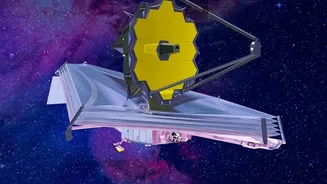
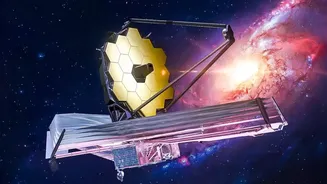
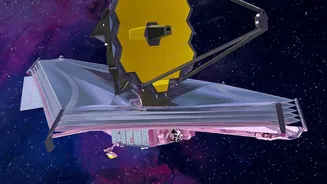
To find something as specific as water from quadrillions of kilometres away, you need a special kind of vision. The James Webb Space Telescope sees the universe in infrared light, a spectrum of light that is invisible to the human eye. We feel infrared as heat.
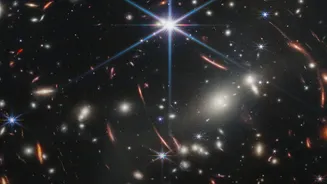
For astronomers, it’s a goldmine. Distant stars and galaxies are so far away that their light gets stretched out as it travels across the expanding universe, shifting into the infrared spectrum. More importantly for planet hunters, infrared light can pierce through cosmic dust clouds that obscure visible light, and it happens to be the frequency where molecules, like water, give off their most obvious tell-tale signs. Before Webb, many of these signals were simply too faint or hidden to capture, leaving us with frustratingly blank stares from potentially fascinating worlds.
The Art of Reading Starlight
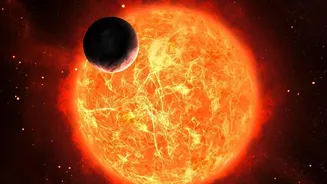
Webb’s primary technique for sniffing out alien atmospheres is brilliantly simple in concept: it’s called transit spectroscopy. This method involves watching a distant star as one of its planets passes, or “transits,” in front of it from our perspective. As the starlight streams through the edge of the planet’s atmosphere, the gases present absorb very specific colours, or wavelengths, of that light. Think of the planet’s atmosphere as a filter. Every chemical element and compound in that filter leaves a unique “fingerprint” on the light that passes through. The result is a spectrum, essentially a barcode of light, that Webb’s sensitive instruments can read. By analysing which colours are missing from the starlight, scientists can determine precisely what the planet's atmosphere is made of.
A Barcode for Water
Water (H₂O) has a very distinct absorption signature in the infrared spectrum. When starlight passes through an atmosphere containing water vapour, the water molecules absorb light at specific infrared wavelengths, causing a noticeable dip in the light received by the telescope. Instruments like the Near-Infrared Spectrograph (NIRSpec) and the Mid-Infrared Instrument (MIRI) were designed specifically to capture these dips with incredible precision. What astronomers receive is a graph showing the brightness of light at different wavelengths. Where there's a significant drop that matches the known pattern for water, they can confidently confirm its presence. While water has been found on gaseous planets before, Webb’s power allows it to detect atmospheres around smaller, rockier worlds, which were previously much harder to study.
Water in a Planet Nursery
One of the most exciting discoveries came from the PDS 70 system, about 370 light-years away. There, Webb detected water vapour not in a fully formed planet’s atmosphere, but in the inner disk of gas and dust where new, rocky planets are currently assembling. This was the first time water has been found in the terrestrial, or rocky-planet-forming, region of a system already known to host protoplanets. This discovery is profound because it suggests that planets like Earth may have access to water from the very beginning of their formation, rather than relying on later delivery by comets or asteroids. It means the key ingredient for life as we know it is available right where and when it’s needed.
More Than Just Rain Clouds
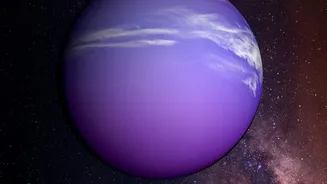
Webb’s sensors are revealing far more than just water. On the exoplanet WASP-107b, a so-called “fluffy” planet less dense than cotton candy, astronomers found not only water vapour but also sulfur dioxide and, remarkably, clouds made of silicate particles—essentially, sand. On other worlds like K2-18 b, a candidate “Hycean” planet, Webb has detected carbon-bearing molecules alongside water, hinting at a potential ocean world beneath a thick hydrogen atmosphere. These findings show that Webb is not just a water detector; it's a comprehensive alien weather station. It provides data on temperature, atmospheric dynamics, and the presence of other chemicals, painting a complete picture of these distant environments and helping scientists understand the sheer diversity of worlds that exist in our galaxy.