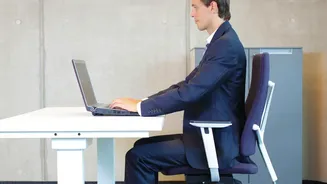







The Problem with Prolonged Sitting
Working remotely has blurred the lines between the office and home, often leading to longer hours spent in chairs not designed for full-time work. This sedentary lifestyle is a primary cause of poor posture, often called 'tech neck' or forward head posture, where
the head juts forward and shoulders round. Over time, this places immense strain on the neck and upper back muscles, leading to stiffness, headaches, muscle imbalances, and chronic pain. The human body simply wasn't designed to stay in one position for eight hours a day. The good news is that introducing small, regular movements, often called micro-breaks, can significantly counteract these negative effects.
1. The Chin Tuck for Tech Neck
This is arguably the most critical exercise to combat forward head posture. It strengthens the deep muscles in the front of your neck, which help hold your head in proper alignment over your shoulders. How to do it: Sit or stand tall, looking straight ahead. Gently pull your chin straight backward as if you are trying to make a double chin, without tilting your head up or down. You should feel a stretch at the back of your neck. Hold this position for 5 seconds and then relax. Aim to repeat this 10 times. It’s a subtle movement, but done consistently, it helps retrain your muscles to maintain better posture throughout the day.
2. Seated Cat-Cow for Spinal Mobility
Prolonged sitting can make your spine rigid. The cat-cow stretch, adapted for your chair, helps to gently mobilize the vertebrae and relieve tension. How to do it: Sit at the edge of your chair with your feet flat on the floor and your hands on your knees. On an inhale, arch your back, push your chest forward, and look up toward the ceiling (Cow pose). On an exhale, round your spine, tuck your chin to your chest, and let your shoulders curve forward (Cat pose). Flow between these two positions for 60 seconds, syncing the movement with your breath. This simple sequence promotes blood flow and flexibility along your entire spine.
3. Thoracic Spine Rotations for Upper Back
Your upper and mid-back (thoracic spine) can become incredibly stiff from hunching over a laptop. These rotations help to gently unlock that area. How to do it: Sit upright in your chair. Cross your arms over your chest, with your hands on your opposite shoulders. Keeping your hips and lower body still, slowly rotate your upper body to the right as far as feels comfortable. Hold for a moment, then rotate back to the center and over to the left. Continue alternating sides for about 60 seconds. This helps improve rotational mobility and eases the stiffness that builds up between your shoulder blades.
4. Doorway Chest Stretch to Open Up
Constant sitting and typing causes the muscles in the chest to become tight, which pulls the shoulders forward and contributes to a hunched posture. Opening up the chest is a crucial counter-movement. How to do it: Stand in a doorway and place your forearms on the frame, with your elbows bent at a 90-degree angle. Gently step one foot forward until you feel a light stretch across your chest and the front of your shoulders. Hold the stretch for 20-30 seconds, breathing deeply. Do not force the stretch; it should feel relieving, not painful. This exercise directly counteracts the slouched position of desk work.
5. Seated Hip Flexor Stretch
When you sit for hours, the muscles at the front of your hips, the hip flexors, become short and tight, which can contribute to lower back pain. How to do it: Sit towards the edge of your chair. Extend your left leg straight back as far as you can, keeping your right knee bent with your foot on the floor. You can hold onto your desk for balance. You should feel a stretch along the front of your left hip. For a deeper stretch, gently squeeze the glute muscle of the extended leg. Hold for 20-30 seconds, then carefully switch sides. This helps lengthen those tight hip muscles and relieve pressure on your lower back.