





The Universe’s Ghostly Messengers
Imagine a particle so ethereal it can pass through an entire planet without a trace. That’s a neutrino. Trillions of these “ghost particles” are streaming through you every second. They have almost no mass and no electric charge, meaning they barely interact
with anything. While this makes them incredibly difficult to detect, it’s also their superpower. Unlike light, which gets blocked by dust and gas, neutrinos travel in a straight line from their source, carrying pristine information across billions of light-years. They are cosmic messengers, born in the most extreme environments imaginable: exploding stars (supernovae), the hearts of active galaxies powered by supermassive black holes, and gamma-ray bursts. By catching these particles, we can effectively look inside the universe’s most violent and hidden engines.
Catching a Ghost Is Hard Work
Detecting a neutrino is an exercise in patience and scale. Since they so rarely interact with matter, the only way to catch one is to build a detector of truly colossal size. The current champion is the IceCube Neutrino Observatory, which has turned a cubic kilometre of ultra-pure ice at the South Pole into a giant detection grid. When a neutrino, by a stroke of luck, crashes into an atomic nucleus in the ice, it produces a tiny flash of blue light called Cherenkov radiation. More than 5,000 light sensors buried deep in the ice wait to spot these flashes. IceCube has been revolutionary, proving that high-energy neutrinos come from beyond our galaxy and even identifying the first likely sources. But it also has its limits; it can only spot the brightest events, leaving much of the neutrino sky uncharted.
Meet the Real ‘Shadow Blaster’
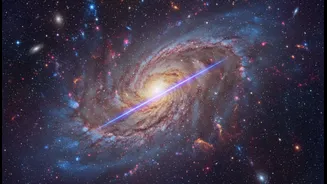
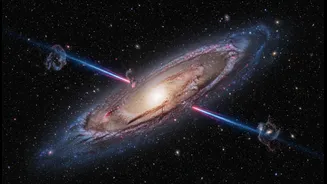
The headline’s “Shadow Blaster” isn’t a new detector, but rather a new type of source that was recently identified. In mid-2026, astronomers announced they had traced a high-energy neutrino detected in 2021 back to a distant galaxy nicknamed the Shadow Blaster. The name is fitting: it’s a galaxy heavily obscured by dust (the “shadow”) but is furiously creating stars (the “blast”). This discovery was a surprise. Previously, scientists thought that only galaxies with active supermassive black holes could produce such energetic neutrinos. The Shadow Blaster, however, appears to be a starburst galaxy, its energy coming from intense star formation. This finding suggests that a whole new class of objects, numerous throughout the early universe, could be powerful neutrino factories, fundamentally changing our understanding of where these cosmic messengers originate.
A New Generation of Ghost Traps
To find more sources like the Shadow Blaster, scientists are building a new generation of even more powerful neutrino telescopes. The successor to IceCube, called IceCube-Gen2, will expand the detector volume to eight cubic kilometres, making it five times more sensitive. But the hunt is also moving to the deep ocean. The Pacific Ocean Neutrino Experiment (P-ONE), off the coast of Canada, will use a cubic kilometre of sea water as its detector, complementing IceCube by watching the southern sky. Even more ambitious is China's TRIDENT project in the South China Sea, which aims to instrument a staggering 10 cubic kilometres of water, making it the largest detector of its kind. These new observatories will not only detect more neutrinos but will also pinpoint their origins with much greater accuracy, enabling a true map of the high-energy universe.
A Clearer View of Cosmic Violence
The combination of knowing where to look (at starburst galaxies like the Shadow Blaster) and having far better tools to do so (like IceCube-Gen2, P-ONE, and TRIDENT) is set to revolutionize astronomy. For the first time, scientists will be able to systematically survey the sky for neutrino sources, rather than just catching the odd one here and there. This will provide direct insight into the physics of cosmic rays—high-energy particles whose origins have been a century-long mystery. By coordinating with gravitational wave and traditional light-based telescopes, this new era of “multi-messenger astronomy” will give us a complete, 360-degree view of the universe's most cataclysmic events. We will move from seeing faint outlines to drawing a detailed picture of the engines that power the cosmos.