




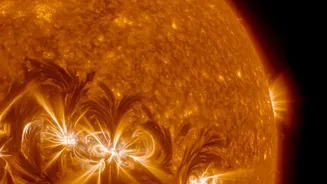
The Sun’s Powerful Outbursts
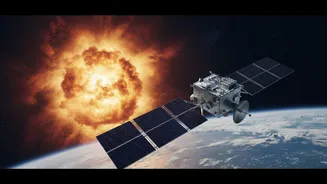
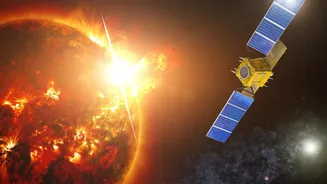
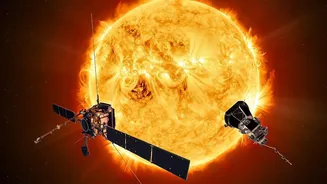
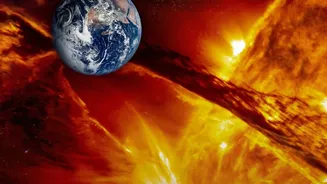
The process begins with a violent event on the Sun called a coronal mass ejection, or CME. A CME is a massive expulsion of plasma and magnetic fields from the Sun's outer atmosphere, the corona. These are not small events; they can eject billions of tons
of material into space, traveling at speeds from under 250 kilometers per second to nearly 3000 km/s. When a CME is directed at Earth, this colossal cloud of charged particles travels across the 150 million kilometers of space, creating the potential for a geomagnetic storm. The fastest CMEs can make this journey in as little as 15-18 hours, while slower ones may take several days.
Building a Virtual Solar System
To forecast a CME's impact, scientists can't just watch it; they have to predict its path and characteristics. They do this using complex computer models. One of the most important is the WSA-Enlil model, used by forecasters at the National Oceanic and Atmospheric Administration (NOAA). This system is actually two models in one. The first part, the Wang-Sheeley-Arge (WSA) model, uses data from solar telescopes to map the Sun's magnetic field and estimate the conditions of the solar wind near the Sun. This provides the baseline environment through which a CME will travel.
Simulating the Impact
The second part, Enlil (named after the Sumerian god of wind), is a 3-D magnetohydrodynamic model that simulates the CME's journey through the inner heliosphere. When forecasters detect a CME using spacecraft like the Solar and Heliospheric Observatory (SOHO), they use coronagraph images to determine its initial speed, direction, and size. They input this data—often represented as a 'cone'—into the Enlil model. The simulation then plays forward, showing how the CME cloud propagates through and interacts with the ambient solar wind, predicting its arrival time at Earth and its likely intensity.
The All-Important Magnetic Field
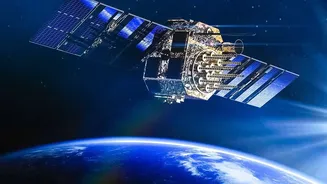
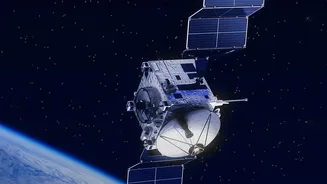
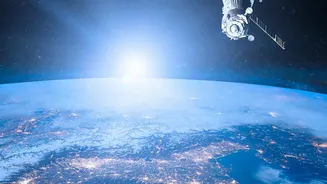
A key factor determining a geomagnetic storm's severity is the orientation of the CME's magnetic field. If its magnetic field is pointing south—opposite to the direction of Earth's own magnetic field—it can more efficiently transfer energy into our planet's magnetosphere, triggering a stronger storm. While models provide an initial forecast, satellites stationed at a point 1.5 million kilometers from Earth, called Lagrange Point 1 (L1), act as a final checkpoint. Spacecraft like the Deep Space Climate Observatory (DSCOVR) directly measure the properties of the incoming CME, including its magnetic field direction, giving a crucial 15-to-60-minute advance warning before it hits Earth.
Why This Cosmic Forecast Matters
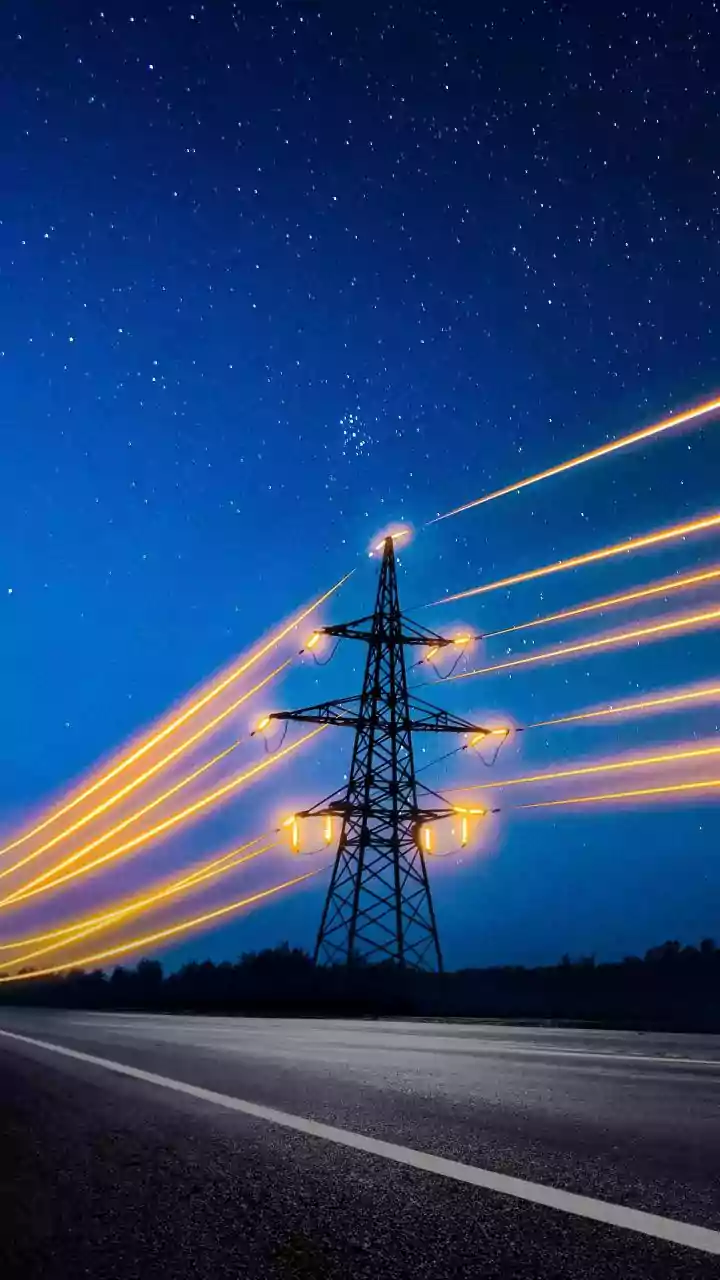
This work isn't just academic. Severe geomagnetic storms can have serious consequences for our technology-dependent society. They can induce extra currents in power grids, potentially leading to widespread blackouts like the one that hit Quebec in 1989. These storms can also disrupt radio communications, degrade GPS navigation accuracy, increase orbital drag on satellites, and even pose radiation risks to astronauts. By providing a 1-to-4-day advance warning, these sophisticated simulations give power grid operators, satellite controllers, airlines, and other vital services time to take protective measures, safeguarding our infrastructure from the Sun's fury.