






A Witness to Seven Centuries
For generations, the story of the sprawling banyan tree on the Indian Tobacco Company (ITC) campus in Munger was tied to the nearby Burra Bunglow, a colonial-era structure. Local belief held that the tree, a traditional gathering spot, was planted around
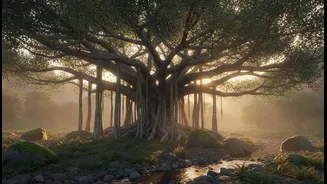
the same time as the 350-year-old building. But a recent scientific discovery has completely rewritten that history. Researchers have now confirmed the tree is approximately 700 years old, making it the oldest accurately dated banyan tree in the world. This revelation means the tree was not planted for the bungalow; rather, the bungalow was built in the shade of a giant that was already centuries old. This ancient banyan is likely a surviving remnant of a natural forest that once covered the region, having silently witnessed the fall of dynasties, the dawn of British rule, and the birth of modern India.
From Folklore to Scientific Fact
Determining the true age of tropical broadleaf trees like the banyan (Ficus benghalensis) has long been a challenge for scientists. Unlike trees in temperate climates, they do not produce distinct annual growth rings, making traditional dating methods ineffective. Ages were often estimated based on folklore or historical accounts, leaving room for uncertainty. The breakthrough for the Munger tree came from a team led by scientists at the Birbal Sahni Institute of Palaeosciences in Lucknow. They employed a high-precision technique typically used in archaeology: radiocarbon dating. By extracting a stable component called alpha-cellulose from the tree's core wood samples and analysing it, they were able to establish a reliable scientific age. This innovative approach has not only given the Munger banyan its rightful place in history but has also created a new scientific framework for dating other ancient tropical trees around the globe.
A Statewide Heritage Mission
The story of the Munger banyan is the most prominent example of a much larger movement taking root across Bihar. The state government, through the Bihar State Biodiversity Board (BSBB), has launched an ambitious initiative to identify, document, and conserve its 'heritage trees'. To engage the public in this effort, the board developed the 'Bihar Heritage Tree App', allowing citizens to upload photos and GPS locations of trees they believe are over 50 years old and hold cultural or ecological significance. The response has been overwhelming, with over 15,000 trees listed in the app's first phase. Experts are now physically verifying these entries, with dozens already officially designated as 'Biodiversity Heritage Trees' across districts like Munger, Aurangabad, and Buxar. This formal recognition ensures these natural monuments receive special protection, funding for their care, and a place in the official record of Bihar's living legacy.
The Undeniable Climate Connection
Protecting these ancient trees is about more than preserving history; it is a critical climate action. A single large, mature tree like the Munger banyan is an ecological powerhouse. Its vast canopy provides cooling shade, mitigating the urban heat island effect, while its complex root system helps maintain soil health and water tables. More importantly, ancient trees are massive carbon sinks. Over their long lives, they sequester and store tonnes of carbon dioxide from the atmosphere, playing an outsized role in the fight against climate change. They also function as biodiversity hotspots, providing habitats for countless species of birds, insects, and other animals within their sprawling branches and trunks. By treating these trees as invaluable natural assets, Bihar is not just honouring its past but also investing in a more resilient and sustainable future. Their preservation is a powerful, nature-based solution to some of our most pressing environmental challenges.