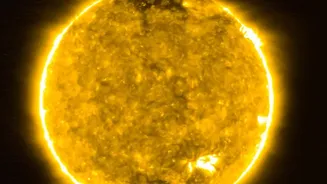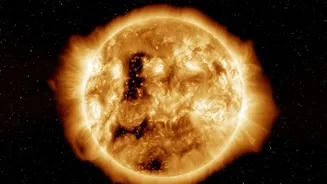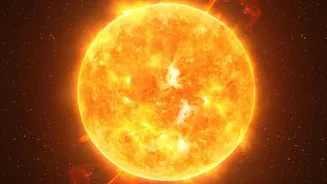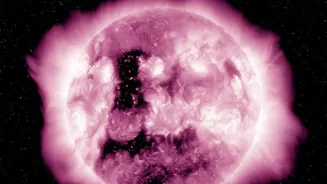


Our Sun feels like a permanent fixture in the sky, but it's a middle-aged star with a finite lifespan. In about five billion years, it will begin a dramatic transformation that will reshape our solar system and end with a quiet, cooling ember.
The Beginning of the End
The Sun
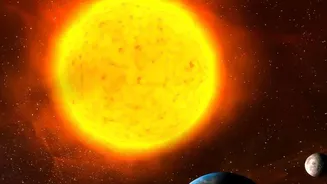
is currently about 4.6 billion years old, comfortably in its main sequence phase. It generates energy by fusing hydrogen into helium in its core. This process provides the outward pressure that balances the inward pull of gravity, keeping our star stable. However, this fuel supply is not infinite. In approximately five billion years, the hydrogen in the core will run out. Without the energy from fusion, gravity will take over, causing the core to contract and heat up. This increased temperature will ignite hydrogen fusion in a shell surrounding the core, causing the Sun's outer layers to expand dramatically. Our star will swell into a red giant, potentially growing more than 100 times its current size.
A Red Giant's Fury
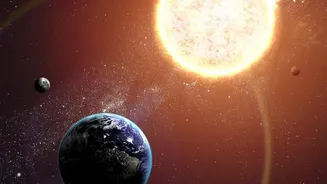
During its red giant phase, the Sun's expansion will be catastrophic for the inner solar system. It is expected to engulf and vaporize Mercury and Venus. Earth's fate is less certain, but most models predict it will also be consumed. Even if our planet narrowly escapes being swallowed, the intense heat will boil its oceans and strip away its atmosphere, rendering it a lifeless, molten rock. After this expansion, the Sun will shed its outer layers, creating a beautiful, glowing structure known as a planetary nebula. Left behind will be the incredibly dense, hot core of the former star: a white dwarf.
The White Dwarf Remnant
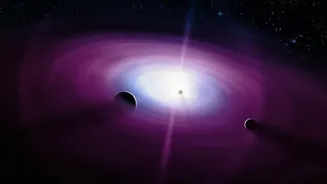
A white dwarf is the final evolutionary stage for stars like our Sun. It will contain about half the Sun's original mass packed into a sphere roughly the size of Earth. A single teaspoon of its material would weigh several tons. With no nuclear fusion to produce energy, the white dwarf will simply be a cooling ember, radiating its leftover heat into space over billions of years. Recent studies based on data from the Gaia space observatory have provided strong evidence for the next stage in this cooling process: crystallization. As the white dwarf cools, its carbon and oxygen core will literally freeze, forming a solid crystal lattice. This process releases latent heat, which temporarily slows down the cooling and causes the dead star to shine a bit brighter for a period.
A Chaotic New Solar System
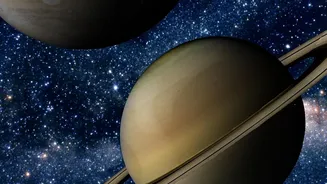
While the inner planets will be gone, new models suggest the outer solar system's story is far from over. As the Sun loses mass during its red giant phase, its gravitational pull will weaken. This will cause the surviving planets—Jupiter, Saturn, Uranus, and Neptune—to drift into wider, less stable orbits. For a long time, it was thought this new configuration would remain peaceful. However, recent simulations suggest a more chaotic future. The gravitational jostling could lead to planets being ejected from the solar system entirely or sent on collision courses with each other. Instead of a quiet, orderly system, the Sun's death could trigger billions of years of cosmic demolition among the remaining giants. Some research even suggests that asteroids and comets from the outer reaches will be knocked from their orbits, falling toward the white dwarf and being shredded by its intense gravity, forming a debris ring around the stellar remnant.
Fading to Black
Even after the planets have settled into their final, chaotic dance, the white dwarf Sun will continue its slow fade. For trillions of years—a timescale far longer than the current age of the universe—it will continue to cool. Eventually, it will radiate away all its remaining heat and become a cold, dark, and invisible object known as a black dwarf. This theoretical final state represents the true end of our Sun's long and eventful life, a silent monument in the cold emptiness of space. Although planets can survive their star's death, and new habitable zones can even form temporarily around a cooling white dwarf, our solar system is ultimately destined for a quiet, frozen, and dark finale.