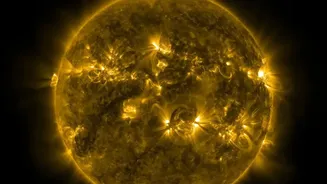




A Surface of Boiling Vortices
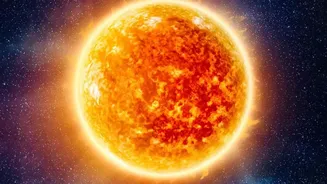
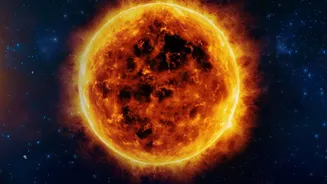
Imagine looking at the Sun and seeing not just a bright light, but a surface covered in countless swirling whirlpools of plasma. Using the world's most powerful solar telescope, astronomers have recently done just that. They captured the first direct
images of tiny plasma vortices, some as small as 12 to 20 kilometres wide, dotting the Sun's visible surface, known as the photosphere. These structures are born from a phenomenon known as the Kelvin-Helmholtz instability, which occurs when fluids or gases moving at different speeds meet. Think of wind blowing over water, creating waves. On the Sun, this happens at the edges of granules—bubbling convection cells of plasma that are each the size of a small country. These newly seen vortices demonstrate how even the smallest processes can shape the nature of our entire star.
Seeing the Sun in Unprecedented Detail
Observing these minuscule swirls is a monumental technical achievement. The feat required the immense power of the Daniel K. Inouye Solar Telescope in Hawaii, the largest of its kind on Earth. To put its power into perspective, spotting these 20-kilometre structures on the Sun is like trying to identify a coin from over 70 miles away. Researchers combined the telescope's observations with advanced computer simulations to confirm what they were seeing. For the first time, they could resolve features at the very limit of what is physically possible to see, providing concrete evidence for fluid dynamics theories that, until now, had only been simulated in models. This new level of detail allows scientists to move from theoretical predictions to direct observation, opening a new chapter in solar physics.
Solving the Sun's Hottest Mystery
One of the most persistent puzzles in astrophysics is the coronal heating problem: why is the Sun's outer atmosphere, the corona, millions of degrees hotter than its surface? These newly discovered plasma waves may hold the key. Scientists believe these vortices act like mixers, twisting and churning magnetic fields. This process can transport enormous amounts of energy from the Sun's surface up into the much thinner corona. The discovery of other waves, like the long-theorised torsional Alfvén waves, further supports the idea that the Sun's atmosphere is heated by a complex interplay of magnetic wave activity. By studying how these waves travel and dissipate their energy, scientists hope to finally build a complete model of how the corona gets, and stays, so incredibly hot.
Why It Matters for India and Earth
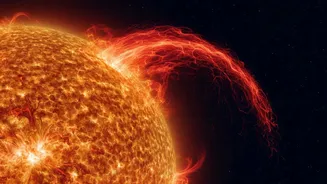
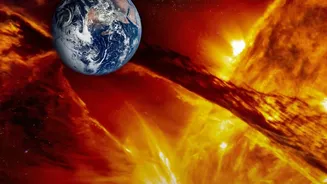
Understanding the Sun isn't just an academic exercise; it has direct implications for our technology-dependent life on Earth. The same magnetic energy that heats the corona can also power solar flares and coronal mass ejections (CMEs)—massive explosions that hurl plasma into space. If aimed at Earth, this 'space weather' can cripple satellites, disrupt communication networks, and even bring down power grids. By monitoring these newly visible plasma vortices, scientists hope to better predict when and where these larger, more dangerous eruptions might occur. This research is especially relevant for India, whose Aditya-L1 solar observatory is already making crucial contributions. Positioned 1.5 million kilometres from Earth, Aditya-L1 recently provided unprecedented details of a solar flare's origin, observing it in a wavelength range never seen before with such clarity. Together, ground-based telescopes and space missions like Aditya-L1 are creating a comprehensive picture of the Sun, enhancing our ability to forecast space weather and protect our vital infrastructure.