






A Cosmic Time Machine
To understand Webb’s discoveries, it’s crucial to grasp how it looks into the past. Because light travels at a finite speed, the light from distant objects takes millions or even billions of years to reach us. When Webb observes a galaxy 13 billion light-years
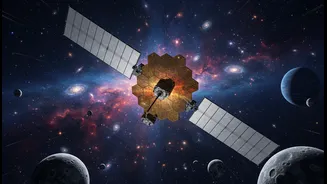
away, it’s seeing that galaxy as it was 13 billion years ago, not long after the Big Bang. This ability allows astronomers to piece together the history of the universe, observing how stars and galaxies formed and evolved over cosmic history. Webb is specially designed to capture infrared light, which is essential for two reasons. Firstly, the light from the most ancient objects has been stretched into infrared wavelengths by the expansion of the universe. Secondly, infrared light can pierce through the dense clouds of gas and dust where new stars and planets are born, regions that are opaque to visible-light telescopes like Hubble.
The Birthplace of Planets
Stars are born from the gravitational collapse of vast, cold clouds of gas and dust. What’s left over from this process forms a swirling, flattened pancake of material around the newborn star called a protoplanetary disk. This disk is the nursery where planets are made. For millions of years, tiny dust grains within this disk collide and stick together, gradually building up into pebbles, then larger bodies, and eventually, full-fledged planets. The composition of this disk is the starting recipe for the planets that will form within it. Webb’s instruments can analyze the chemical makeup of these disks with unprecedented detail, effectively reading the ingredients list for future worlds.
Connecting the Star to Its Worlds
Recent discoveries from Webb have powerfully demonstrated the link between a parent star and its future planets. By studying protoplanetary disks, astronomers are seeing how the environment around a young star dictates the kind of planets that can form. For instance, Webb has shown that powerful jets and winds from a protostar can launch materials forged in the hot, inner part of the disk—like crystalline silicates—out to the cold outer edges where comets form. This helps explain a long-standing mystery of why comets in our own solar system contain heat-formed crystals. Another study revealed a planet-forming disk surprisingly rich in carbon dioxide and poor in water, challenging standard models and suggesting the star's intense radiation was reshaping the disk's chemistry. By analyzing the chemical makeup of these nurseries, Webb is connecting the star’s early, violent life directly to the raw materials available for planet formation.
A Glimpse into Our Own Past and Future
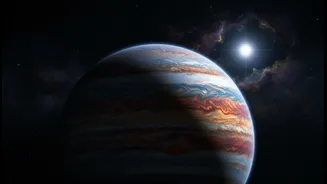
These observations are not just about distant, alien systems; they are a window into our own solar system's infancy. By studying young stars and their disks at various stages, we get snapshots of what our Sun and planets might have looked like 4.6 billion years ago. The discovery of long-lasting protoplanetary disks around smaller stars, for example, suggests that some planetary systems have much more time to form and evolve than previously thought. This has implications for the development of complex systems like TRAPPIST-1. In another fascinating twist, Webb has even offered a glimpse into our solar system's distant future. By studying a Jupiter-like planet orbiting a dead star, or white dwarf, astronomers can see what might become of our own outer planets long after our Sun has died. This is a rare case of using a telescope to look forward in time, predicting the fate of a planetary system.