

Why Your Hips Get Stiff
Our bodies are not designed for prolonged sitting. When you're seated for hours, your hip flexors—the muscles at the front of your hips—remain in a shortened, flexed position. Over time, this can lead to tightness and stiffness. Meanwhile, your glute
muscles can become inactive or weakened, creating an imbalance that puts extra strain on your lower back and knees. This combination of tight flexors and weak glutes is a common cause of the discomfort many desk workers feel. The good news is that regular, gentle movement can help prevent and alleviate this stiffness, promoting better blood flow and joint health.
1. Seated Figure-Four Stretch
This is one of the most effective and discreet stretches you can do right at your desk. It targets the deep external rotators of the hip, including the piriformis and glute muscles. To perform it, sit tall in your chair with your feet flat on the floor. Cross one ankle over the opposite knee, creating a 'figure four' shape. Keeping your spine straight, gently lean forward from your hips until you feel a comfortable stretch in the glute of the crossed leg. Avoid slouching your back; the movement should be a hinge from your hips. Hold for 20-30 seconds, breathing deeply, and then switch to the other side. Do this several times throughout the day to release tension.
2. Standing Hip Circles
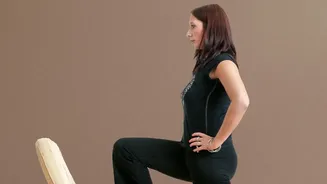
Breaking up your sitting time is crucial, and this movement is perfect for those moments when you stand up. Stand with your feet hip-width apart and place your hands on your hips for balance. Lift one foot slightly off the ground and begin to make slow, controlled circles with your knee, as if you are drawing a circle in the air. Make five to ten circles in one direction, then reverse. This movement helps lubricate the hip joint and improves its range of motion. After completing the circles on one leg, switch to the other. It’s a simple way to get your hips moving and improve stability.
3. Kneeling Hip Flexor Stretch
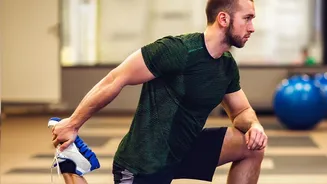
To counteract the shortening of hip flexors from sitting, you need to lengthen them. The kneeling lunge is an excellent way to do this. Kneel on one knee, using a cushion for comfort if needed, and place your other foot flat on the floor in front of you with your knee bent at a 90-degree angle. Keeping your torso upright, gently push your hips forward until you feel a stretch in the front of the hip of your kneeling leg. Be careful not to arch your lower back. For a deeper stretch, you can raise the arm on the same side as the kneeling leg towards the ceiling. Hold for 30 seconds and then switch sides.
4. Glute Bridges
Activating the glutes is just as important as stretching the hip flexors. Strong glutes provide stability and take pressure off the lower back. To do a glute bridge, lie on your back with your knees bent, feet flat on the floor about hip-width apart, and your arms by your sides. Gently squeeze your glutes and lift your hips off the floor until your body forms a straight line from your shoulders to your knees. Hold for a few seconds at the top, focusing on the glute contraction, then slowly lower your hips back down. Aim for 10-15 repetitions. This exercise helps 'wake up' the muscles that become dormant from sitting.
5. Cat-Cow Pose
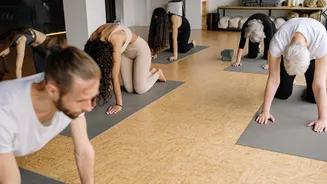
While often associated with yoga, the Cat-Cow pose is a fantastic mobility exercise for the entire spine and pelvis, which is closely linked to hip health. Start on your hands and knees with your wrists under your shoulders and your knees under your hips. As you inhale ('Cow' pose), drop your belly towards the floor and look forward, allowing your lower back to arch gently. As you exhale ('Cat' pose), press into your hands, round your spine towards the ceiling, and tuck your chin to your chest. Flowing between these two positions for 10-15 cycles helps improve pelvic tilt and relieves tension in the lower back and hips.