






First, What Is Intuitive Eating?
Before we dive into our daals and rotis, let's clarify what we're talking about. Coined by dietitians Evelyn Tribole and Elyse Resch in 1995, intuitive eating is an anti-diet philosophy. It's not about rules, but principles. The core idea is to reconnect
with your body's natural hunger and fullness signals. It involves rejecting the 'diet mentality' of good vs. bad foods, learning to honour your hunger, feeling your fullness, and finding satisfaction in your meals. It’s about building a healthy relationship with food, mind, and body, free from the guilt and restriction that modern diet culture often promotes.
The Thali: A Masterclass in Satisfaction
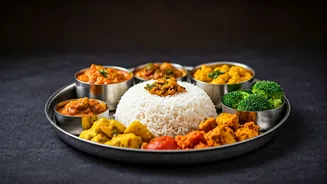
One of the key principles of intuitive eating is to 'discover the satisfaction factor'. A traditional Indian thali is a perfect embodiment of this. It’s not just a platter of food; it's a balanced ecosystem on a plate. A typical thali offers a variety of textures and all six tastes (sweet, sour, salty, pungent, bitter, and astringent) through its components: dal, sabzi, roti or rice, salad, pickle, and perhaps a small sweet. This diversity doesn't just nourish the body with various nutrients; it satisfies the palate completely. When your senses are fully engaged and satisfied, you're less likely to overeat in search of that missing 'something'. It’s built-in portion control and sensory satisfaction, guiding you to feel content, not just full.
Honouring Hunger, The 'Maa Ke Haath' Way
Intuitive eating asks you to 'honour your hunger'. For generations, Indian mothers have been the keepers of this wisdom. Think about it: the question isn't just "Have you eaten?" but "Are you hungry?" The culture of 'maa ke haath ka khana' is centred on nourishment and love, not rigid schedules. Food is offered when hunger strikes. This approach teaches us from a young age to recognise and respond to our body's cues for energy. It moves away from the strict, clock-based eating that can disconnect us from our internal signals and instead fosters a responsive, trusting relationship with our appetite.
Eating with the Seasons and Senses
Another intuitive principle is to 'respect your body', which includes choosing foods that make you feel good. Traditional Indian food wisdom, heavily influenced by Ayurveda, has always championed eating seasonally. We crave cooling foods like cucumber and watermelon in the summer and warming foods like ginger and bajra in the winter for a reason. This practice is inherently intuitive. It's about syncing our bodies with nature's rhythms. Furthermore, the Indian tradition of eating with your hands is a powerful tool for mindful eating. The tactile connection to your food slows you down, making you more aware of texture, temperature, and ultimately, how much you're consuming. You're more present in the moment, which helps you better register fullness.
Making Peace with Ghee and Mithai
Western diet culture is notorious for creating food villains. One week fat is bad, the next it’s carbs. Intuitive eating encourages you to 'make peace with food' and challenge these labels. In a traditional Indian context, foods are rarely seen as purely 'good' or 'bad'. Ghee isn't a villain; it’s a source of nourishment and flavour. Mithai isn't a 'cheat meal'; it's a part of celebration and daily life in moderation. Festivals are incomplete without their specific delicacies. This approach views food as holistic — part of culture, celebration, and health. By ditching the restrictive labels, we can enjoy these foods without guilt, which paradoxically gives them less power over us and reduces the likelihood of bingeing.