



The Standard Story of the Cosmos
For about 50 years, cosmology has been dominated by a powerful and successful theory known as the Lambda-Cold Dark Matter (ΛCDM) model. It’s the story you might have learned in school: about 13.8 billion years ago, the universe burst into existence with
the Big Bang. In this model, the universe is made of about 5% normal matter (stars, planets, us), 27% mysterious “cold dark matter,” and 68% even more mysterious “dark energy” (represented by the Greek letter Lambda) that drives cosmic expansion. This model has been incredibly effective, explaining everything from the leftover glow of the Big Bang, called the Cosmic Microwave Background, to the large-scale structure of galaxies. It provided a neat, tidy, and well-tested timeline of our cosmic history.
A Webb of Complications
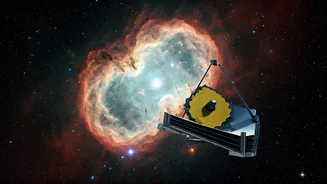
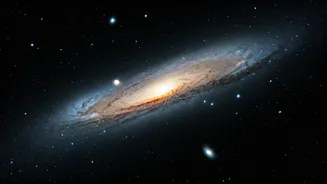
The story started getting complicated with the launch of the James Webb Space Telescope (JWST). As an infrared telescope, it can peer further back in time than any previous instrument, into the era of the very first stars and galaxies. Almost immediately, JWST started finding things that shouldn't exist according to the standard model. It found massive, well-formed galaxies that were already in place when the universe was just a few hundred million years old—a cosmic infant. According to ΛCDM, galaxy formation is a slow, bottom-up process; it should have taken billions of years to build such large structures. Finding these “impossible early galaxies” was like finding a fully grown adult in a nursery.
The Galaxy Formation Puzzle
These early galaxies aren't just surprisingly large; they're also surprisingly mature and complex. Astronomers have found evidence of early galaxy mergers and collisions happening far earlier than predicted, a process that helps shape galactic evolution. Some of these ancient galaxies show chemical signatures, like carbon and nitrogen, that suggest they have already hosted multiple generations of stars. Another puzzle comes from objects nicknamed “little red dots.” Initially thought to be compact galaxies, some now appear to be supermassive black holes growing at an astonishing rate, potentially without a host galaxy at all. This challenges our understanding of how these cosmic giants form, as they appear too big, too soon.
The Crisis of Expansion
It’s not just JWST causing headaches for cosmologists. For years, another problem has been brewing, known as the “Hubble Tension.” This refers to a persistent disagreement between two different methods of measuring the universe's expansion rate, called the Hubble constant. Measurements of the nearby, modern universe give one value (around 73 km/s/Mpc), while measurements of the early universe from the cosmic microwave background give a different, slower value (around 67 km/s/Mpc). Despite increasingly precise measurements, this gap has not closed; in fact, recent studies have confirmed the discrepancy is real and significant, suggesting our understanding of cosmic evolution might be missing a key ingredient. A recent measurement using gravitational waves from a neutron star merger added more fuel to the fire, finding a value closer to the early universe measurement.
Rewriting the Cosmic Playbook
So, is cosmology broken? Not quite. Scientists are now exploring a host of new ideas to explain these observations. Some theories propose that the first stars were far more massive and efficient at building galaxies than previously thought. Others suggest that the rules of gravity or the nature of dark energy might change over cosmic time. One headline-grabbing proposal even suggests the universe could be twice as old as we think, around 26.7 billion years, which would give these early galaxies plenty of time to form. While this is a minority view, it shows how willing scientists are to question core assumptions. The current moment is less a crisis and more a scientific revolution in progress, driven by new, undeniable data.