



From a Hint of Vapour to a Working System
For decades, the holy grail of exoplanet discovery was finding traces of water. Using powerful telescopes, scientists can detect the chemical signature of water vapour in the atmospheres of planets hundreds of light-years away. This is typically done
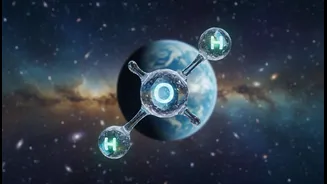
through a method called transit spectroscopy. When a planet passes in front of its host star from our point of view, a tiny fraction of the starlight filters through the planet's atmosphere. By analysing the spectrum of this light, astronomers can identify the molecules present, including the tell-tale signs of H2O. The James Webb Space Telescope (JWST) has been a game-changer in this field, with its incredible sensitivity allowing it to spot subtle water features even in the scorching atmospheres of super-hot gas giants. But finding vapour is just the first step. It proves the ingredients for water are there, but it doesn't prove the existence of a stable system of clouds, rain, and oceans—a true water cycle.
Why a Water Cycle is Crucial for Life
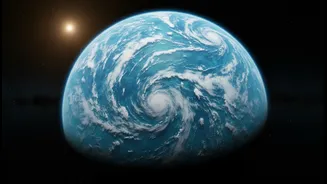
A functioning water cycle does much more than just provide a place for potential alien fish to swim. On Earth, the water cycle is a planetary engine that is essential for life as we know it. It distributes fresh water across continents through evaporation, condensation, and precipitation, replenishing lakes and rivers. This process is vital for agriculture and supports diverse ecosystems. Crucially, the water cycle also regulates the climate by redistributing heat around the globe. Water evaporates at the surface, absorbing heat, and releases that heat when it condenses into clouds high in the atmosphere. Without this constant circulation, Earth would experience much more extreme temperatures. A stable water cycle, therefore, provides the temperate, life-sustaining environment that allows complex organisms to thrive. Finding one on an exoplanet would be a monumental leap in identifying a world that is not just wet, but truly habitable.
The Hunt for Alien Weather
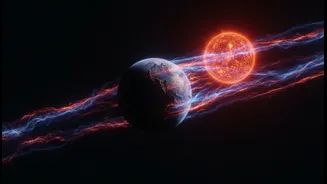
So, how do you spot a weather system on a planet you can't even see directly? Scientists employ a range of clever and complex techniques. One method involves observing the planet over its entire orbit to create a 'phase curve'. As the planet rotates, telescopes like the JWST can measure the thermal emissions from different parts of its surface and atmosphere, mapping temperature differences between the day and night sides. This can reveal how heat is being transported, which on a habitable planet would likely be by winds and storms. For example, observations of the hot Jupiter WASP-121 b using the Hubble Space Telescope allowed astronomers to track how water molecules were broken apart on the scorching dayside and reformed on the cooler nightside, creating an exotic, high-altitude water cycle. Other methods look for more indirect clues, such as comparing the amount of carbon dioxide in a planet's atmosphere to its neighbours, as lower levels could indicate the presence of a large ocean that has absorbed the gas.
Promising Candidates and Future Discoveries
The search has already yielded some tantalising targets. Planets like K2-18 b, a 'super-Earth' that may be a water-rich 'Hycean' (hydrogen and ocean) world, are prime candidates for follow-up studies. Early observations suggest the possibility of a global ocean beneath a thick atmosphere. More recently, an atmosphere was detected around the rocky exoplanet LHS 1140 b, which sits comfortably in its star's habitable zone, making it a compelling target to search for signs of water and a climate system. Scientists believe it has many of the right ingredients for habitability, including a temperature that could support liquid water and an atmosphere to protect it. While the detection of a full water cycle on an Earth-like world remains just out of reach, each new observation brings us closer. Researchers are refining their models and using the unprecedented power of the JWST to move from detecting elements to understanding systems. It's a shift from planetary cataloguing to planetary meteorology.