


Earth's Unruly Twin Planet
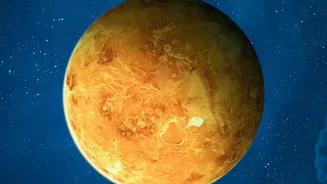
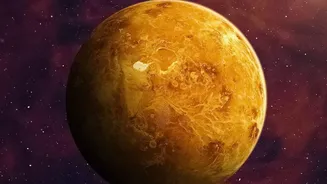
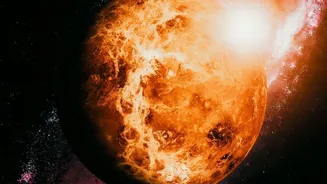
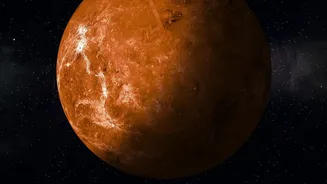
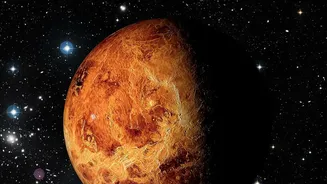
Venus is a planet of extremes. With surface temperatures soaring to 467 degrees Celsius and an atmosphere 92 times denser than Earth's, it’s a stark example of a runaway greenhouse effect. Its skies are permanently shrouded in thick clouds of sulfuric
acid. But beneath this hostile exterior lies a fascinating natural laboratory. For decades, scientists have looked at Venus not just as our neighbor, but as a cautionary tale and a scientific goldmine. It's the most Earth-like planet in the solar system in terms of size and mass, yet it followed a dramatically different evolutionary path. Understanding why is central to planetary science, offering profound insights into how a temperate, water-bearing world—which some models suggest Venus once was—can become an inferno.
The Volcanic Fingerprint: Sulfur Dioxide
A key player in Venus’s dramatic story is sulfur dioxide (SO2). On Earth, SO2 is a well-known byproduct of volcanic eruptions, but it gets washed out of our atmosphere by rain. In the bone-dry environment of Venus, it lingers, playing a critical role in the planet's chemistry and cloud formation. Scientists have observed huge fluctuations in the amount of SO2 in Venus’s upper atmosphere for decades. These spikes and subsequent declines have long been interpreted as strong, albeit indirect, evidence for active volcanism. The theory is simple: massive volcanic eruptions periodically inject huge plumes of SO2 into the atmosphere, which then slowly dissipate. This process makes SO2 a vital tracer—a chemical fingerprint—of geological activity happening on the hidden surface below.
The Smoking Gun of Active Volcanoes
For years, the idea of active volcanoes on Venus was a compelling theory without definitive proof. That has changed dramatically. By painstakingly analyzing archival radar data from NASA's Magellan mission in the 1990s, scientists found the 'smoking gun.' Studies published in 2023 and 2024 revealed direct geological evidence of volcanic activity. Researchers identified a volcanic vent that changed shape and grew, consistent with a major eruption. Further analysis showed new lava flows, confirming that Venus is not geologically dead but is, in fact, a world with ongoing eruptions, potentially on a scale comparable to Earth. This confirmation galvanizes the study of the planet, solidifying the link between the SO2 in its atmosphere and a dynamic, churning interior.
A Blueprint for Distant Worlds
So, why does a volcanic flare-up on Venus matter for understanding 'cosmic' climate patterns? Because Venus serves as our best local analog for a huge class of planets outside our solar system. As telescopes like the James Webb Space Telescope discover thousands of exoplanets, many are found to be rocky worlds orbiting in the 'Venus Zone' of their stars—too close for liquid water but perfect for developing a runaway greenhouse effect. These 'exo-Venuses' are often easier to detect and study than their more temperate, Earth-like cousins. By studying our own Venus in detail, we get a crucial head start. We learn what chemical signatures, like sulfur dioxide, to look for in the atmospheres of these distant worlds.
Decoding Exoplanet Atmospheres
When a telescope detects sulfur dioxide in the atmosphere of a rocky exoplanet, scientists can use Venus as a Rosetta Stone. The models built to understand the relationship between volcanism, SO2, and cloud formation on Venus can be adapted to interpret this distant data. The presence of SO2 could imply a geologically active world, which has major implications for the planet's evolution and its potential to host life. Understanding how a Venus-like atmosphere works also helps scientists distinguish between different types of planets. For example, learning how volcanic outgassing can create oxygen without life (abiotic oxygen) is critical for interpreting potential biosignatures on other worlds. In essence, every secret we unlock from Venus's sulfurous haze provides a new tool for decoding the climates of planets hundreds or thousands of light-years away.