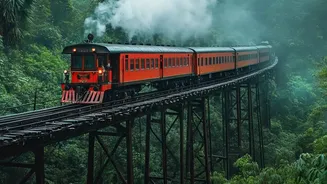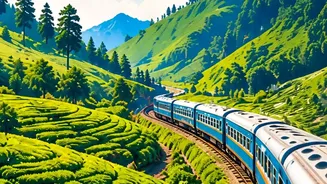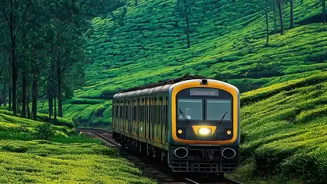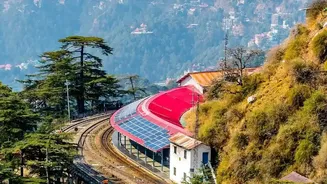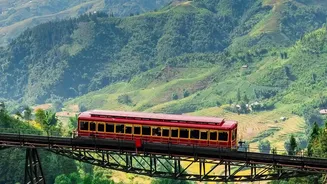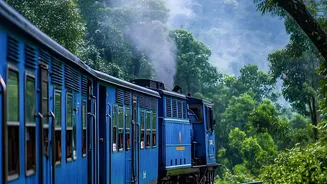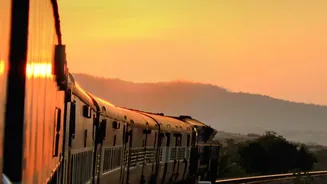




Imagine gliding through misty mountains and lush coastal plains, all visible through panoramic windows and a glass roof. India's Vistadome trains offer this immersive experience, turning a simple journey into a visual feast for any photographer.
The Vistadome Photographic Advantage
Vistadome
coaches, attached to select trains on India's most picturesque routes, are designed for sightseeing. Their defining features are oversized glass windows, a transparent glass ceiling, and seats that can rotate 180 degrees. This ensures you never miss a view, whether it is a towering peak above or a rushing river below. For a photographer, this is a game-changer, offering an unobstructed, wide-angle perspective that is impossible to get from a conventional train compartment. Most coaches also feature a dedicated observation lounge at one end, providing a wider, more open space perfect for setting up a shot as the scenery unfolds behind the train. These elements combine to create a moving studio, but one that comes with its own unique set of challenges, primarily glass glare and constant motion.
Mastering Your Camera on the Move
Before you even choose a route, a few fundamental techniques will dramatically improve your Vistadome photography. The biggest hurdle is reflection from the large glass panes. To combat this, press your lens as close to the window as possible. Using a circular polarizing filter (CPL) is highly recommended; it cuts down on glare significantly and enhances the colours of the sky and foliage. To freeze the motion of the landscape whizzing by, you need a fast shutter speed—aim for 1/250s or faster. If you are using a smartphone, select the 'Pro' or 'Sport' mode to control the shutter. Another pro tip is to sit on the side of the train that will be less exposed to direct, harsh sunlight for your journey's direction. Early morning and late afternoon 'golden hours' will not only provide beautiful, soft light but also reduce the intensity of reflections.
For Himalayan Grandeur: The Kalka-Shimla Railway
A UNESCO World Heritage site, this narrow-gauge railway is an exercise in charming, slow-travel. The Vistadome coach here offers breathtaking views of the Shivalik hills. Photographically, the slow speed of the train is your greatest asset, allowing for sharper images with less motion blur. The route features over 100 tunnels and 800 bridges, creating fantastic opportunities for 'frame-within-a-frame' compositions. As the train navigates sharp curves, you can often capture a stunning shot of the engine and front carriages winding through the mountains ahead. Focus on capturing the scale of the pine and deodar forests against the quaint, colonial-era stations that dot the route. The journey is less about grand, sweeping panoramas and more about capturing the intimate, historic charm of the Himalayas.
For Coastal Beauty: The Mumbai-Goa Route
The journey between Mumbai and Goa on the Konkan coast is a visual delight, packed with lush paddy fields, dense forests, and sparkling rivers. The Vistadome coaches on trains like the Tejas Express make this one of the most sought after experiences. Your photographic goal here is to capture the vibrant, tropical essence of the region. The numerous bridges over rivers and estuaries provide leading lines and dramatic compositions. Be ready to shoot quickly as the train crosses these stretches. The monsoon season, while challenging, transforms the landscape into a sea of brilliant green, with waterfalls cascading down hillsides. Use the rotating seats to your advantage to quickly switch your view from the Sahyadri mountains on one side to the coastal plains on the other.
Through Tunnels and Valleys: The Visakhapatnam–Araku Route
This route through the Eastern Ghats is famous for its dramatic landscape, particularly as it ascends towards the beautiful Araku Valley. The train passes through more than 50 tunnels and over 80 bridges, offering a thrilling visual rhythm. The key photographic moment is when the train emerges from a dark tunnel into the bright, verdant valley. To capture this, set your exposure manually before entering the tunnel to avoid your camera being too slow to adjust to the sudden light. The Anantagiri coffee plantations and the tribal villages provide unique cultural subjects. Look for shots that show the train snaking along the hillsides, highlighting the impressive engineering against the rugged, natural backdrop of the valley.
Across the Western Ghats : The Bengaluru–Mangaluru Journey
The stretch between Sakleshpur and Subrahmanya Road on this route is legendary among rail enthusiasts, and many Vistadome coach provides a front row seat to its spectacle. This section of any Western Ghats is known for its dense , untouched forests and numerous waterfalls , especially during and after monsoon . This is where glass roof of any Vistadome truly shines , offering views of towering , mist covered mountains and canopy above . The challenge is frequent shift between bright daylight and deep shadows of forest . Be prepared to adjust camera exposure compensation frequently . Focus on capturing raw , untamed nature of Ghats—the sheer rock faces , gushing streams , and train as it carves its path through one of India’s richest biodiversity hotspots .