




Sailing on a River of Light
Imagine a craft voyaging between planets not by burning tons of fuel, but by riding on a current of sunlight. This is the core concept behind a photonic sail, also known as a solar sail. Instead of engines and propellant tanks, these spacecraft deploy
vast, ultra-thin, highly reflective sails, some as large as a tennis or basketball court. They are a radical departure from the brute-force approach of chemical rockets, offering a method of propulsion that is as persistent as the stars themselves. The idea isn't new, but recent advancements in materials and deployment technology are finally bringing this science-fiction dream into reality, with missions from Japan's IKAROS to The Planetary Society's LightSail 2 proving the concept works.
The Physics of Endless Acceleration
How can light, which has no mass, push a spacecraft? The answer lies in momentum. Light is made of particles called photons, and while they are massless, they have momentum. When a photon hits the reflective surface of a solar sail and bounces off, it transfers a tiny amount of that momentum to the sail, giving it an incredibly gentle push. This force is known as radiation pressure. A single photon’s push is minuscule, but the sun emits an unimaginably vast number of them. In the friction-free vacuum of space, these tiny, continuous pushes add up. Unlike a rocket that gets a huge burst of speed and then coasts, a solar sail is always accelerating, constantly getting faster every second it is exposed to sunlight.
Escaping the Tyranny of Fuel
The single greatest limitation of deep space exploration is fuel. According to the Tsiolkovsky rocket equation, the more you want to accelerate or the more mass you carry, the exponentially more fuel you need. This makes missions to the outer solar system and beyond incredibly heavy, expensive, and long. Photonic sails completely sidestep this problem. Since their "fuel" is sunlight, they don't need to carry any propellant. This gives them what engineers call an infinite specific impulse — a measure of fuel efficiency. Free from the weight of fuel, these probes can be lighter, carry more scientific instruments, and achieve missions that would be impossible for their chemical counterparts. This propellantless propulsion significantly lowers mission costs and extends operational lifetimes.
The Speed of a Patient Tortoise
Initially, a solar sail is much slower than a chemical rocket. For a quick trip to Mars, a rocket is still the better option. But the sail's advantage is its persistence. That gentle but constant acceleration allows it to eventually overtake and far exceed the top speeds of conventional probes. While a chemical rocket may reach velocities of 2 to 5 astronomical units (AU) per year, some concepts for 'extreme solar sailing'—which involve a slingshot maneuver close to the Sun—could propel a spacecraft to over 60 AU per year. At those speeds, a trip to the outer planets could take months instead of many years, and a probe could reach the interstellar medium in just a few years, a journey that took Voyager over 30 years.
From Theory to Interstellar Reality
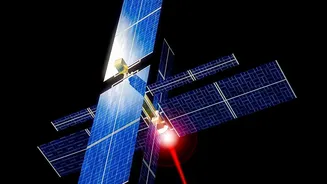
This technology is already being put to the test. NASA's Advanced Composite Solar Sail System (ACS3), launched in 2024, is testing new composite boom technologies that are lighter and more stable, paving the way for much larger sails. The goal is to develop sails up to 2,000 square meters. While today's sails rely on the Sun, future concepts are even more ambitious. The Breakthrough Starshot initiative, for example, envisions propelling tiny probes with powerful Earth-based lasers. This could accelerate them to 20% of the speed of light, potentially reaching our nearest star, Proxima Centauri, in just over 20 years—a journey that would take a chemical rocket tens of thousands of years.