






A Messenger From Another Star
On July 1, 2025, astronomers using the ATLAS telescope in Chile spotted a faint point of light moving with unusual speed and trajectory. They soon realized it was not from around here. Named 3I/ATLAS, it was confirmed as the third interstellar object
ever detected passing through our solar system, following 'Oumuamua in 2017 and 2I/Borisov in 2019. Unlike our solar system's planets, asteroids, and comets, which are all gravitationally bound to the Sun, 3I/ATLAS was moving too fast on a path that showed it came from deep space and would eventually return to it, never to be seen by us again.
The Ultimate Time Capsule
Here's where the time travel comes in. When we look at a star 100 light-years away, we see it as it was 100 years ago. But 3I/ATLAS is not just light; it's a physical object, a time capsule that has journeyed for potentially billions of years from its home star system. Some studies suggest the comet could be ancient, possibly originating from the Milky Way's 'thick disk'—a population of old stars—making it potentially older than our own solar system. By studying its composition, we are getting a direct sample of the chemical building blocks from another part of the galaxy, providing a glimpse into the conditions of a planetary system that formed in a distant time and place.
What Can This Visitor Teach Us?
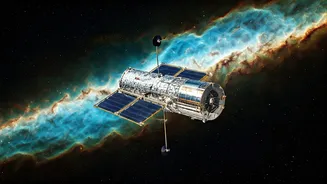
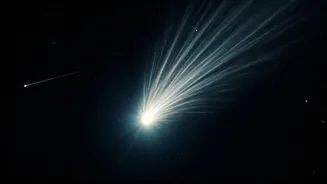
3I/ATLAS is an active comet, a ball of ice and dust with a nucleus estimated to be a few kilometers wide. As it neared our Sun, its ice began to vaporize, creating a cloud of gas and dust called a coma. Telescopes like the Hubble and James Webb Space Telescopes were trained on the comet, analyzing this material. They found water, carbon dioxide, and even cyanide gas, but in ratios different from comets in our own solar system. This unique chemical fingerprint tells scientists about the environment where 3I/ATLAS was born, offering invaluable clues about how planets and comets form around other stars.
A Fleeting But Historic Visit
The comet's journey was a carefully tracked celestial event. It made its closest approach to the Sun on October 29, 2025, passing just inside the orbit of Mars. Thankfully, it posed no threat to Earth, passing our planet at a safe distance of about 270 million kilometers in December 2025. As of mid-2026, 3I/ATLAS has passed the orbit of Jupiter and is heading back out into the void of interstellar space. The global campaign to observe it involved multiple space agencies and telescopes, all working together to gather as much data as possible from this rare guest before it disappeared forever.