





Why Europa? The Allure of a Hidden Ocean
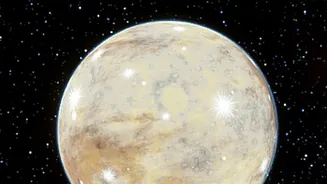
From the outside, Europa looks like a smooth, frozen billiard ball, crisscrossed with reddish-brown cracks. It is one of the smoothest solid objects known in our solar system. But beneath its icy shell, which could be several kilometres thick, scientists
have strong evidence of a vast, global ocean of liquid saltwater. In fact, this hidden ocean may contain more than twice the amount of water found in all of Earth's oceans combined. The key to this watery world is a phenomenon called tidal flexing. Europa's elliptical orbit around the colossal planet Jupiter causes it to be constantly squeezed and stretched by gravity. This process is believed to generate enough heat to keep the ocean from freezing solid, and could even power hydrothermal vents on the seafloor, similar to those on Earth that teem with life.
Meet the Clipper: A Robotic Explorer on an Epic Journey
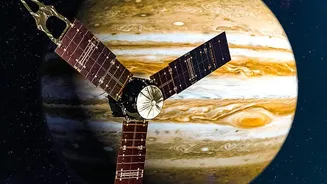
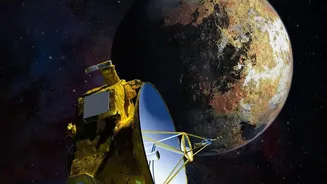
To investigate this tantalising world, NASA designed and launched the Europa Clipper spacecraft. Having launched in October 2024, it is the largest spacecraft ever developed by the agency for an interplanetary mission. Its most striking features are its massive solar arrays, which span the length of a basketball court and are needed to power the craft so far from the Sun. The mission is a long-haul flight; the spacecraft is scheduled to arrive in the Jupiter system in April 2030 after a nearly six-year journey. To protect its sensitive electronics from Jupiter's ferocious radiation belts, the main instruments are housed within a heavily shielded vault with thick aluminum walls.
A Mission of Flybys, Not Landing
Instead of orbiting Europa directly, which would expose it to a fatal dose of radiation, the Clipper will enter a long, looping orbit around Jupiter. From there, it will perform a series of nearly 50 meticulously planned, high-speed flybys of Europa. During these close encounters, the spacecraft will swoop from altitudes as high as 2,700 kilometres down to a breathtaking 25 kilometres above the surface. This clever strategy allows the mission to gather detailed data from different regions across almost the entire moon while minimising time spent in the most dangerous radiation zones. This orbital ballet will allow for a comprehensive survey without the immense challenge and risk of attempting a landing on the icy, unknown surface.
The Toolkit for Finding Signs of Life
Europa Clipper is equipped with a suite of nine advanced scientific instruments designed to assess Europa's habitability. While it is not designed to find life itself, it will search for the "ingredients for life" as we know it: liquid water, essential chemical elements, and a source of energy. Its ice-penetrating radar, REASON, will probe the icy shell to confirm the ocean's existence and measure the shell's thickness. Spectrometers like MISE and Europa-UVS will analyse the composition of the surface ice and thin atmosphere, looking for salts, organic molecules, and other chemical clues. Crucially, instruments like the SUDA dust analyser and MASPEX mass spectrometer will attempt to sample any plumes of water vapour that might be venting into space from the ocean below, effectively tasting the ocean without touching it.
What Are 'Microbial Signals'?
The ultimate goal is to determine if Europa has environments that could support life. The "microbial signals" mentioned in headlines refer to biosignatures—the chemical fingerprints life leaves behind. This doesn't mean finding living microbes, but rather the complex organic molecules or unusual chemical ratios that are difficult to explain without a biological origin. For example, if the Clipper's instruments were to detect a complex mix of amino acids or lipids in a water plume, it would be a monumental discovery. The mission is a reconnaissance mission; its primary goal is to characterise the ocean and ice shell to understand if this distant moon could be a habitable world.