



Cosmic Cradle of Chemicals
Recent astronomical observations have peeled back the veil on the chemical origins of our universe, suggesting the recipe for life is far older than previously imagined. Scientists have discovered a trove of complex organic molecules (COMs) swirling in the icy
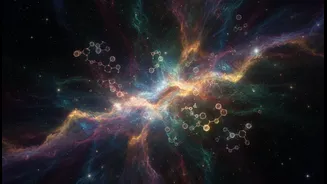
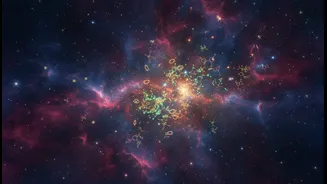
dust clouds around protostars — stellar infants that have not yet ignited. These aren't just simple compounds; researchers have identified molecules like ethanol, acetic acid (the acid in vinegar), and even a type of sugar called erythrulose, which is found in raspberries here on Earth. The term Complex Organic Molecule in astrochemistry refers to carbon-based molecules with six or more atoms. The presence of these molecules in the cold, dark nurseries where stars are born indicates that the chemical complexity needed for life doesn't wait for planets to provide a stable home. The raw materials are already present in the stellar cradle.
A Glimpse into the Past
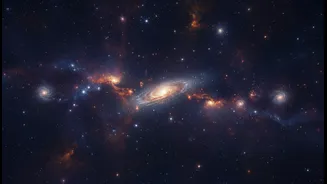
These groundbreaking discoveries are largely thanks to the unprecedented power of new astronomical tools, especially the James Webb Space Telescope (JWST). Its sensitive instruments can peer into the dense, cold molecular clouds where stars begin their lives—environments that were previously difficult to study. By analyzing the light that passes through these icy cocoons, astronomers can detect the unique spectral fingerprints of different molecules. It’s like cosmic forensics; the light reveals which chemicals are present, frozen onto dust grains. Detections have been made in several star-forming regions within our Milky Way, such as the Orion Nebula and the Taurus Molecular Cloud. Even more remarkably, some of these life-friendly molecules have been found around a protostar in the Large Magellanic Cloud, a neighboring dwarf galaxy, suggesting this prebiotic chemistry is not unique to our galactic neighborhood.
The Recipe for Habitable Worlds
The discovery of COMs in these pre-planetary stages has profound implications for how we understand the origin of life. For decades, a key question has been whether life's ingredients formed in the volatile conditions of early Earth or were delivered from space. Evidence has mounted for the latter, with molecules like sugars and amino acid precursors found in meteorites and asteroid samples. These new findings provide a missing link, showing that such molecules are synthesized in abundance in interstellar space before being incorporated into the very materials that form planets, asteroids, and comets. As a protostar evolves, the surrounding disk of gas and dust begins to clump together, forming planetesimals. The icy grains, carrying their precious cargo of organic molecules, become part of these new worlds from the very beginning. This means that a planet could be 'seeded' with the ingredients for life as it forms.
From Stardust to Life
While molecules like ethanol and acetic acid are a long way from a living organism, they are considered crucial precursors. For instance, some of the detected molecules are chemical stepping stones to amino acids and the nucleobases that form RNA and DNA. The discovery of a sugar like erythrulose is particularly exciting because sugars form the backbone of our genetic material. The research suggests that the chemical processes that can lead to biology are a universal feature of star formation. Instead of being a rare accident, the potential for life might be a common outcome of the way stars and planets are born. This doesn't guarantee life is everywhere, but it does suggest that the fundamental ingredients are widely distributed across the cosmos, waiting for the right conditions to emerge.