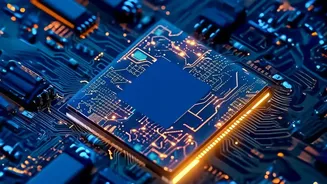









India is making a monumental push into one of the world's most critical industries. A reported $23 billion investment aims to establish the nation as a semiconductor powerhouse, with a massive new fabrication plant in Gujarat as its crown jewel.
The Crown Jewel in Dholera
At the
heart of India's semiconductor strategy is a colossal fabrication plant, or 'fab', being built in Dholera, Gujarat. This facility is a venture by Tata Electronics, in partnership with Taiwan's Powerchip Semiconductor Manufacturing Corporation (PSMC). The project represents an investment of approximately ₹91,000 crore (around $11 billion) and is India's first major foray into commercial wafer fabrication. The goal is to produce up to 50,000 wafers per month. These chips are foundational components for a vast range of products, including automobiles, smartphones, data centers, and AI hardware. The government has officially approved the project, and with a target to begin commercial production by 2028, it signals a serious commitment to building a domestic high-tech manufacturing ecosystem.
A Nationwide $23 Billion Bet
The Gujarat fab, while significant, is just one part of a much larger national strategy. The headline figure of $23 billion refers to the total investment the Indian government has earmarked to build a resilient, end-to-end semiconductor industry. This initiative, known as the India Semiconductor Mission (ISM), aims to attract global manufacturers and develop a network of suppliers and ancillary services. Besides the Tata fab in Gujarat, the government has approved several other key projects, including a chip assembly and testing facility in Assam, also led by the Tata Group, and other packaging units in Gujarat. The strategy is to build capabilities across the entire value chain, from chip design and fabrication to assembly and testing (ATMP/OSAT).
Why Chips, and Why Now?
The global pandemic exposed a critical vulnerability in the world's supply chains: an over-reliance on a few East Asian countries for the vast majority of semiconductors. For India, a nation with a booming electronics market and digital economy, this dependence poses both an economic and a strategic risk. Establishing a domestic chip manufacturing base is no longer a luxury but a strategic imperative. It promises to reduce import dependency, create tens of thousands of high-skilled jobs, and position India as a reliable partner in the global tech ecosystem. By making chips locally, India aims to fuel its 'Make in India' initiative and achieve greater self-reliance, or 'Atmanirbhar Bharat', in a sector that underpins modern life.
A Pragmatic Approach to Technology
The Gujarat plant will not initially compete at the cutting edge of chip technology, which involves complex and costly processes. Instead, it will focus on producing chips with mature node sizes, such as 28ndiameter (nm) and larger. While not the most advanced, these chips are workhorses of the industry, widely used in power management, display drivers, microcontrollers, and automotive applications. This is a pragmatic strategy. Starting with mature, highndemand nodes allows India to build foundational expertise, establish reliable production, and serve a massive existing market before attempting to compete with global leaders like TSMC or Samsung on the most advanced technologies.
The Long and Challenging Road to 2028
India's ambitions are high, but the path is fraught with challenges. Previous attempts to build a domestic fab industry have faltered due to regulatory hurdles and a lack of infrastructure. Semiconductor fabrication is one of the most complex manufacturing processes on earth, demanding incredible resources. A fab requires an uninterrupted supply of ultrapure water and electricity, a dustfree environment cleaner than an operating theatre, and a highly specialized workforce. Building this ecosystem from the ground up—including the supply of specialty chemicals, gases, and equipment—is a monumental task that will test the country's execution capabilities. The timeline for the Dholera plant has already seen revisions, reflecting the immense complexity of the undertaking.