






In the rare event of a serious in-flight emergency, a pilot’s training is paramount. Yet, working alongside them is a suite of sophisticated automation tools designed not to replace, but to assist, manage workload, and create precious time.
The Digital Co-Pilot's First Job: Clarity
In an emergency,
the cockpit can become a blizzard of alarms and flashing lights. The first challenge for any flight crew is to cut through the noise and understand the problem. This is where modern alerting systems like Boeing's EICAS (Engine Indicating and Crew Alerting System) and Airbus's ECAM (Electronic Centralized Aircraft Monitor) become invaluable. These systems act as intelligent filters. Instead of presenting every single fault at once, they prioritize them, displaying the most critical issues first in stark colours like red or amber. For example, an engine fire will take precedence over a minor hydraulic issue. The system presents the problem, and in the case of ECAM, it often provides the corresponding checklist of actions directly on screen, guiding the crew through the initial, critical steps. This drastically reduces cognitive load, allowing pilots to focus on flying the plane first while the system provides a clear, ordered path for troubleshooting.
Keeping the Aircraft Within Safe Limits
During a sudden crisis, a pilot's instinct might be to make a sharp, aggressive control input. Modern fly-by-wire (FBW) aircraft have a safety net for this, known as 'flight envelope protection'. Instead of physical cables, pilot inputs are sent as electronic signals to computers, which then command the aircraft's control surfaces. These computers are programmed with the aircraft's safe operating limits—its maximum speed, bank angle, and angle of attack (to prevent a stall). If a pilot, reacting to a startling event, pulls back too hard on the controls, the system will not allow the aircraft to enter a stall. It interprets the pilot's intent—to climb or avoid an obstacle—and provides maximum possible performance without exceeding safe aerodynamic limits. This protection was famously highlighted during the successful ditching of US Airways Flight 1549, where the system allowed the pilot to maintain optimal glide performance without stalling. It acts as a guardrail, giving pilots the confidence to make bold manoeuvres when necessary.
Automating the Descent in a Depressurization
One of the most time-critical emergencies is a rapid cabin depressurization at high altitude, which can lead to hypoxia—a lack of oxygen that can incapacitate the crew within seconds. To counter this, advanced aircraft like the Airbus A350 feature an Automatic Emergency Descent (AED) system. This system constantly monitors cabin pressure. If a dangerous drop is detected and the pilots do not respond within a short timeframe (around 15 seconds), the system assumes they may be incapacitated. It can then automatically engage the autopilot, turn the aircraft away from its programmed route, and initiate a rapid descent to a safe, breathable altitude, typically around 10,000 feet. It's a fail-safe designed to protect everyone on board when the human crew may be physically unable to do so.
The Human-Automation Partnership
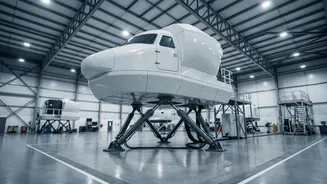
Despite these incredible technologies, automation is not a substitute for a well-trained pilot; it's a tool to augment their skills. The entire philosophy is built around a concept known as Crew Resource Management (CRM), which emphasizes effective communication and the use of all available resources—including technology. Pilots train extensively in simulators for these exact scenarios, learning how to interact with the automation, interpret its messages, and when to take full manual control. The automation is designed to handle the predictable, high-workload tasks, freeing up the pilots' mental capacity to analyze the unique aspects of the emergency, communicate with air traffic control, and make the ultimate command decisions. The goal is to create a robust team where technology manages the mechanics, allowing humans to focus on judgment and creative problem-solving.