



The Ultimate Cosmic Speed Limit
The magic behind this cosmic time travel is a simple, fundamental rule of the universe: light, though incredibly fast, does not travel instantaneously. It moves at a staggering speed of nearly 300,000 kilometres per second. That’s fast enough to circle
the Earth more than seven times in a single second. But across the incomprehensible vastness of space, even this speed isn't enough for the light from stars to reach us right away. Astronomers use a unit called a 'light-year' to measure these cosmic distances. It’s not a measure of time, but of distance—specifically, the distance light travels in one year. This is about 9.5 trillion kilometres. So, when we say a star is 100 light-years away, it means the light we see from it tonight began its journey a century ago. You aren’t seeing the star as it is today; you are seeing it as it was 100 years in the past.
Greetings from the Mughal Era
Let’s take a familiar celestial landmark: Polaris, the North Star. A constant beacon for navigators for centuries, Polaris seems like a steady, unchanging presence. Yet, it’s approximately 433 light-years away from Earth. This means the faint, shimmering light from Polaris that reaches your eyes tonight started its journey around the year 1591. Think about what was happening in India at that time. The Mughal Empire under Akbar the Great was at its zenith, a period of immense cultural and architectural flourishing. While artists were perfecting miniature paintings in Fatehpur Sikri, the light that would one day form the North Star in our sky was just beginning its long voyage across the cosmos. Every time you spot Polaris, you’re receiving a historical message from the age of emperors and explorers.
A Message from a Dying Giant
Now, let’s look at one of the most dramatic stars in our sky: Betelgeuse. This brilliant red supergiant in the constellation Orion is one of the largest visible stars. It’s also a star nearing the end of its life. Betelgeuse is roughly 640 light-years away. The light we see from it left the star around the year 1384, a time when the Delhi Sultanate was facing immense turmoil. What makes Betelgeuse particularly fascinating is that it’s expected to explode in a spectacular supernova. Astronomers believe it could happen anytime within the next 100,000 years. But because of the light-travel delay, it’s entirely possible that Betelgeuse has already exploded—600 years ago—and the light from that cataclysmic event is still hurtling towards us. We are, in a sense, watching a ticking time bomb on a 640-year delay.
Beyond Stars to Stellar Nurseries
This effect isn't limited to individual stars. Look towards the ‘sword’ of the Orion constellation, and you might spot a fuzzy patch of light. This is the Orion Nebula, a massive stellar nursery where new stars are being born from swirling clouds of gas and dust. It’s one of the most breathtaking sights through a telescope. The Orion Nebula is about 1,344 light-years away. The light we see from this cosmic cradle of creation left around the 7th century CE. It’s a glimpse into a time when the powerful Chalukya and Pallava dynasties reigned in South India, and the great philosopher Shankara was yet to be born. The very process of star birth we are witnessing tonight is an echo from India’s early medieval period.
Looking Back Before Humanity
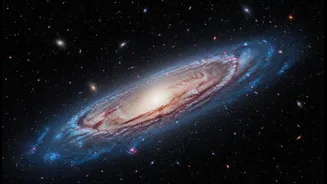
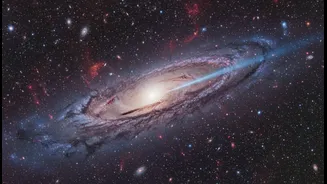
To truly grasp the scale, we must look beyond our own galaxy. On a clear, dark night, far from city lights, you might be able to spot a faint, elongated smudge in the sky. This is the Andromeda Galaxy, our closest major galactic neighbour. It’s a staggering 2.5 million light-years away. The light from Andromeda that we see tonight began its journey long before modern humans, Homo sapiens, even walked the Earth. It’s a photon postcard from a time when our distant ancestors were just beginning to use stone tools in Africa. When you look at the Andromeda Galaxy, you are performing an act of cosmic archaeology with your naked eyes.