



Beyond the Calendar: Why Observation is Key
Many plant enthusiasts believe in repotting annually, but this is a common myth. Most houseplants only need a new pot every three to five years, and some, like snake plants and Hoyas, prefer to be snug in their containers. Repotting too soon or into a pot that
is too large can stress the plant and lead to problems like root rot, as the excess soil holds too much moisture. Instead of marking your calendar, the best approach is to become an observer. Your plant will tell you when it needs more space through a combination of visible cues and the condition of its hidden root system.
Reading the Leaves: Signs of a Cramped Plant
The first clues that a plant might need a new home often appear above the soil. One of the most common signs is a change in its water needs. If you find yourself watering much more frequently because the soil dries out in just a day or two, the roots may have displaced so much soil that there isn't enough left to retain moisture. Another signal is stunted or poor-quality growth. If new leaves are noticeably smaller than older ones, or if the plant stops growing entirely during its active season (spring and summer), it could be struggling for nutrients and space. You might also notice yellowing leaves, especially near the bottom of the plant, or a top-heavy appearance where the plant seems unstable and prone to tipping over.
The Decisive Step: Performing a Root Check
While the plant's behaviour provides strong hints, the only way to be certain is to examine the roots. This is less intimidating than it sounds. To start, gently tip the plant on its side. If the pot is flexible, you can squeeze it to help loosen the root ball. Supporting the base of the plant's stem with one hand, carefully slide the pot off with the other. If the plant is stuck, you may need to run a knife around the inside edge of the pot to free it. Once it's out, you have a clear view of the root system and can accurately assess its condition.
Healthy vs. Root-Bound: What to Look For
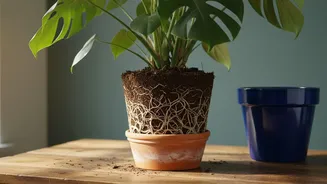
What you see will determine your next move. A plant that is not ready for repotting will have roots mixed with plenty of loose soil. In this case, you can simply slide it back into its pot. A root-bound plant, however, will have a dense mass of roots that have started to circle the inside of the pot, conforming to its shape. You may see more roots than soil. In severe cases, the roots form a solid, tightly wound mat and may even be growing out of the drainage holes or pushing the plant up out of its pot. Healthy roots are typically white or light-coloured and feel firm, while rotting roots, often caused by overwatering, will be brown or black and feel mushy. If you see circling roots, it is time to repot.
Making the Call and Moving Forward
The decision to repot is clearest when you see both behavioural signs and a root-bound system. For example, if your plant is drying out quickly and your root check reveals a dense, circling mass, the answer is yes. If the plant seems happy but the roots are just starting to coil, you can likely wait a little longer. When you do repot, choose a container that is only one size larger—about two to five centimetres wider in diameter. This gives the roots room to expand without overwhelming them with excess soil. Gently loosen any tightly bound roots with your fingers or make a few vertical cuts to encourage them to grow outwards into the new soil. After repotting, water thoroughly once and then wait to fertilize for at least a month to avoid burning the sensitive, newly settled roots.