


Why a Sample Return Mission?
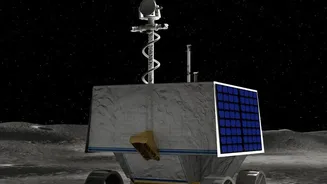
While robotic rovers can perform amazing science on-site, there are limits to the instruments they can carry. Bringing lunar soil, or regolith, back to Earth allows for analysis with state-of-the-art equipment that is far too large and power-hungry to send
to the Moon. These samples, particularly from the unexplored south pole, could hold secrets about the Moon's origin, the history of our solar system, and the presence of water ice, a resource vital for future human exploration. By returning physical samples, India would join an elite club of nations—the US, the former Soviet Union, and China—that have accomplished this feat.
An Ambitious Five-Module Architecture
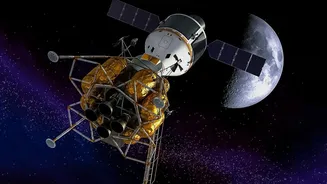
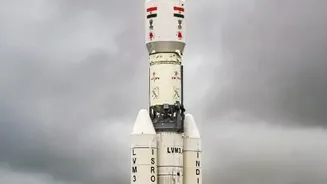
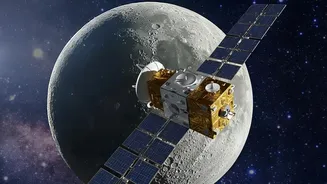
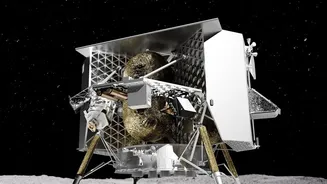
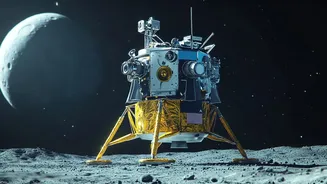
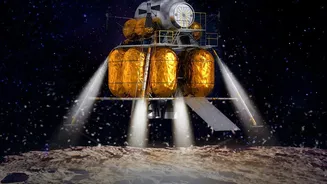
Chandrayaan-4 is a giant leap in complexity from its predecessors, requiring five separate modules. These are the Propulsion Module to travel to the Moon, a Descender for landing, an Ascender to lift off from the lunar surface, a Transfer Module to carry the sample in lunar orbit, and a Re-entry Module to bring it safely to Earth. This intricate design is necessary because the combined weight of the mission is too heavy for a single launch with India's current most powerful rocket, the LVM3.
Two Launches and an Orbital Ballet
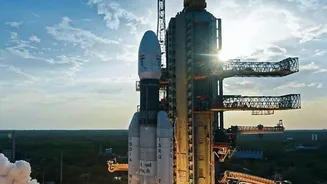
To get this complex assembly to the Moon, ISRO will use a dual-launch strategy. Two LVM3 rockets will lift off from Satish Dhawan Space Centre. One will carry the modules needed for the return journey (Transfer and Re-entry), while the other will carry the modules for landing and ascent (Descender and Ascender). These two spacecraft stacks will then perform a critical manoeuvre never before attempted by ISRO on such a scale: docking in Earth orbit to form one integrated vehicle for the journey to the Moon. This capability was successfully tested with the SPADEX mission, which demonstrated autonomous docking in 2025, significantly de-risking this crucial step for Chandrayaan-4.
The Surface Mission: Scooping and Drilling
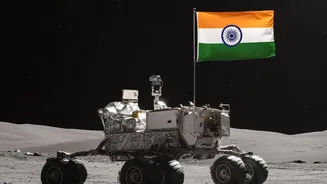
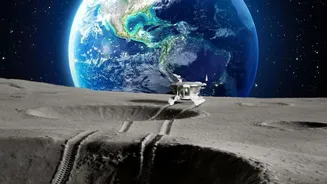
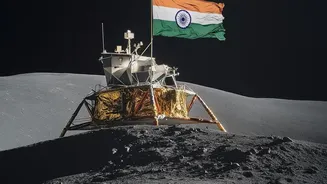
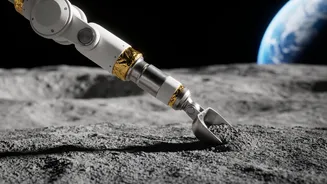
Once in lunar orbit, the Descender and Ascender will separate and land near the Moon's south pole. On the surface, the mission will get to work. A sophisticated robotic arm will scoop up surface soil, while a drill will collect subsurface samples. The goal is to collect up to 3 kg of lunar material and securely seal it in a container housed within the Ascender module. This phase demonstrates advanced robotics and the ability to operate complex machinery in the harsh lunar environment.
The High-Stakes Journey Home
The return journey is arguably the most challenging part of the mission. The Ascender module will use the Descender as a launchpad to lift off from the Moon—another first for India. It will then have to autonomously rendezvous and dock with the Transfer Module waiting in lunar orbit. The sample container will be transferred, and the module will begin its voyage back to Earth. The final test involves the Re-entry Module, which must survive scorching temperatures of up to 2,700 degrees Celsius as it blazes through Earth's atmosphere to deliver its precious cargo.
Timeline and a Stepping Stone to the Future
The Union Cabinet approved the Chandrayaan-4 mission on September 18, 2024, with the launch currently targeted for 2028. This mission is more than just a scientific endeavour; it is a crucial stepping stone. The technologies being proven here—especially automated docking, lunar ascent, and re-entry—are fundamental for India's future space ambitions, including the planned Bharatiya Antariksh Station and the goal of landing an Indian astronaut on the Moon by 2040.