








India has committed an estimated $23 billion to build a domestic semiconductor industry, a move to secure its supply chains and become a global tech player. But while the ambition is huge, creating advanced chips takes years. Here's why.
The Grand Plan: Fabs, Packaging, and Design
India's semiconductor
strategy is a multi-billion-dollar effort to build an entire electronics ecosystem. The plan, under the India Semiconductor Mission (ISM), isn't just about one giant factory. It involves creating different types of facilities. The most complex are semiconductor fabrication plants, or 'fabs', like the $11 billion facility Tata Electronics is building in Dholera, Gujarat. These fabs are where chips are actually 'printed' onto silicon wafers. Other projects focus on Assembly, Test, Marking, and Packaging (ATMP), where finished wafers are cut, tested, and prepared for use. US-based Micron has already started commercial production at its ATMP facility in Sanand, Gujarat. The government is also incentivising chip design, aiming to cover the entire value chain.
Why Building a 'Fab' is So Hard
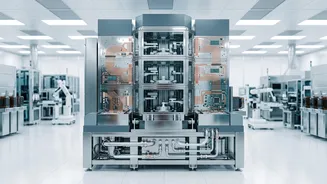
A semiconductor fab is one of the most complex manufacturing environments on Earth. Building one can take three to five years and cost billions of dollars. The central area of a fab is a 'cleanroom', an environment thousands of times cleaner than a hospital operating room. Even a single speck of dust can ruin a batch of microscopic circuits. These facilities require an absolutely stable, uninterrupted supply of massive amounts of power and ultra-pure water, resources that can be a challenge to secure. The machinery inside is also incredibly specialised. For example, lithography machines, which print the chip designs, are made by only a few companies in the world, like ASML in the Netherlands, and a single machine can cost over $120 million.
The Global Supply Chain Puzzle
No country builds chips alone. The semiconductor industry relies on a deeply interconnected global supply chain. A fab in India will still need to import highly specialised gases, chemicals, and the polished silicon wafers that form the base of the chips. While India's plan includes incentives for producing these materials locally, developing that ancillary ecosystem will take years. Experts note that a single fab needs 50 to 100 supporting companies nearby to function efficiently, creating a 'plug-and-play' vendor park like the one planned in Dholera is a critical step. This dependence on a global network for equipment, materials, and maintenance expertise is a major reason why building a self-reliant industry is a long-term project.
The Human Capital Challenge
Beyond the physical infrastructure, chipmaking requires a deep pool of highly specialised talent. India has a strong base of chip designers, but manufacturing requires thousands of engineers and technicians trained in materials science, fabrication processes, and equipment maintenance. Building this workforce doesn't happen overnight. It requires collaboration between industry and academia to create tailored training programs. The government's mission acknowledges this, with talent development being a key pillar of its strategy, but scaling up the skilled workforce to run multiple advanced facilities will be a gradual process.
A Marathon, Not a Sprint
India's approach is strategic, starting with assembly and packaging units, which are less complex, while simultaneously laying the groundwork for fullscale fabs. The Micron plant, for example, handles the final stages of production for memory chips made elsewhere. The Tata fab in Dholera, scheduled to be commissioned by 2028, will produce maturenode chips (like those used in cars and power management devices) rather than the most advanced processors at the heart of the USChina tech rivalry. This phased approach is a recognition of reality: compressing decades of ecosystem development into a few years is a monumental task. Industry experts suggest it can take 10 to 15 years to develop a mature semiconductor ecosystem.