





An Archive Frozen in Time
Imagine a library where every book is a year, and the pages are made of snow. This is essentially what a glacier is. In places like Antarctica and Greenland, where it is consistently cold, snow that falls doesn't melt. Instead, it accumulates, year after
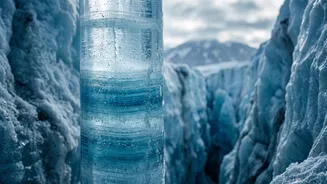
year, with the weight of new layers compressing the old ones below. Over centuries, this immense pressure transforms the granular snow into dense, solid ice. As this process unfolds, something remarkable happens: tiny pockets of air from the atmosphere get trapped between the snow crystals. These bubbles become sealed time capsules, preserving a direct sample of the air as it existed hundreds or even thousands of years ago. By drilling deep into these ice sheets with specialised equipment, scientists can extract long cylinders of ice, known as ice cores. The longest of these cores can be over three kilometres long, offering an unbroken timeline of climate history stretching back as far as 800,000 years.
How to Read a Glacier
Extracting an ice core is only the first step; the real magic lies in its analysis. Scientists can date the cores by counting the distinct annual layers, much like counting tree rings. These layers can be distinguished by seasonal changes in the ice's chemistry and texture, or by identifying layers of ash from known volcanic eruptions. Once dated, the core reveals its secrets. The tiny air bubbles are the most direct evidence. Scientists can carefully extract the trapped air and measure the concentration of greenhouse gases like carbon dioxide (CO2) and methane. This gives them a precise reading of the atmospheric composition from the past. Furthermore, the ice itself serves as a thermometer. By analysing the ratio of different isotopes, or types, of oxygen and hydrogen atoms in the water molecules, researchers can reconstruct past local temperatures. Heavier isotopes are less common in snow that falls during colder periods, providing a reliable proxy for temperature change over millennia.
The Unmistakable Connection
When scientists first began analysing long-term ice core records, such as the landmark data from Russia's Vostok station in Antarctica, they uncovered a startling pattern. The data, which now extends back through multiple ice ages, shows an almost perfect lock-step relationship between atmospheric CO2 concentrations and global temperatures. As CO2 levels rose, temperatures climbed; as CO2 levels fell, the planet cooled. For hundreds of thousands of years, atmospheric CO2 naturally fluctuated between about 180 and 300 parts per million (ppm). This historical context provided by ice cores is crucial because it allows us to see just how dramatic recent changes have been. The data shows that for millennia, the climate was relatively stable, but starting in the 19th century, CO2 levels began a rapid, vertical climb, shattering the 800,000-year record.
The Bedrock of Climate Models
Ice core data is considered foundational because it provides the 'ground truth' for climate science. Before this direct evidence, understanding of past climates was based on indirect proxies like tree rings or sediment analysis. While useful, these methods don't contain actual samples of the ancient atmosphere. Ice cores, however, do. They offer an unambiguous, direct measurement of past greenhouse gas levels, providing a baseline against which modern changes can be measured. This historical data is indispensable for testing and refining the computer models that scientists use to project future climate scenarios. By programming a model with the known atmospheric conditions from an ice core's past, scientists can check if the model accurately simulates the corresponding climate. If it does, it builds confidence in the model's ability to forecast the consequences of today's unprecedented CO2 levels. This validation process makes ice core data not just a record of the past, but an essential tool for understanding the future.