







The End of Toll Booth Queues
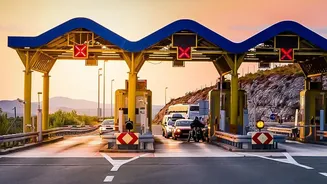
The National Highways Authority of India (NHAI) has implemented a Multi-Lane Free Flow (MLFF) tolling system along the Delhi-Jaipur corridor on National Highway-48. This means the traditional toll plazas, with their stop-and-go barriers, are being eliminated.
With the recent activation at the Shahjahanpur toll plaza, the entire Manesar-to-Jaipur stretch is now barrier-free, following similar upgrades at the Daulatpura and Manoharpura plazas. The goal is to allow vehicles to travel at normal highway speeds without needing to slow down or stop for toll payments, effectively ending the frustrating queues that have long defined highway travel in India.
How the Digital Check System Works
This seamless experience is powered by a combination of two key technologies: FASTag and Automatic Number Plate Recognition (ANPR). As your vehicle passes under large overhead gantries, high-speed RFID scanners read your FASTag, while high-resolution ANPR cameras capture an image of your number plate. The system instantly identifies your vehicle and automatically deducts the correct toll amount from your linked FASTag wallet. This entire process happens in milliseconds as you cruise by at speeds of up to 100 km/h, with a confirmation sent to your registered mobile device. This setup removes the need for any human intervention in the collection process, making it faster and more efficient.
What Commuters Need to Do
For this system to work flawlessly, the responsibility shifts to the vehicle owner. It is crucial to ensure your FASTag is valid, functional, and, most importantly, maintains a sufficient balance. The Ministry of Road Transport & Highways has advised all highway users to keep their FASTag accounts topped up to avoid penalties. If you pass through a barrier-free toll point with an invalid tag or insufficient funds, you won't be stopped. Instead, an electronic notice, or e-notice, will be issued for the non-payment. You will then have 72 hours to pay the standard toll fee. Failure to do so within this window will result in a penalty, and you will be charged double the normal toll amount for your vehicle category.
The Bigger Picture for Indian Highways
The Delhi-Jaipur project is a key part of the government's broader vision to modernize India's transport infrastructure. The successful implementation of MLFF here serves as a critical pilot for a potential nationwide rollout. The primary objectives are to significantly reduce traffic congestion, save fuel, and lower vehicle emissions caused by idling at toll plazas. By eliminating physical barriers, the NHAI also aims to improve the transparency and efficiency of toll collection and reduce the operational costs associated with manual toll plazas. While this technology is currently active at specific pilot locations, its expansion is expected to set a new standard for a truly digital and seamless highway experience across the country.