





What Is a 'Planet Parade'?
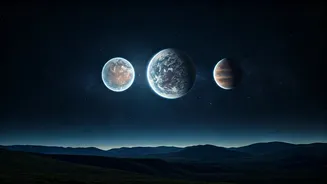
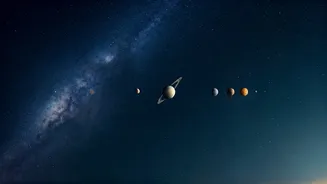
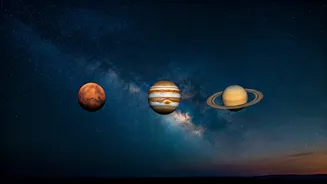
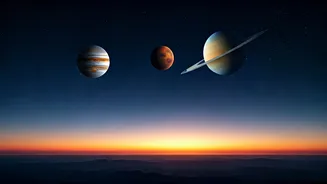
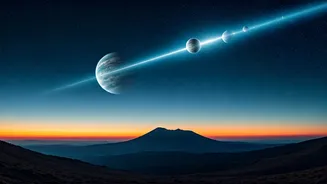
First, let's clarify what a planetary alignment, or 'parade,' really is. The planets in our solar system don't actually line up in a perfect physical row in space. Instead, from our specific vantage point here on Earth, their orbits cause them to appear
grouped together in a small section of the sky. It's a beautiful illusion of perspective. These events aren't astronomically cataclysmic, but they are a fantastic opportunity for stargazers and photographers to see multiple worlds in a single glance. They serve as a wonderful reminder of the dynamic, clockwork nature of our solar system.
The Key Players in the Sky
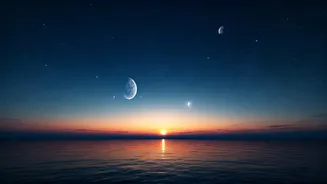
The upcoming celestial gathering will feature three notable objects. The main attractions are Mars and Saturn. Mars will be identifiable by its distinct reddish-orange hue, a colour that has earned it the name 'the Red Planet.' It will shine steadily, unlike twinkling stars. Nearby, Saturn will appear as a calmer, yellowish-white point of light. While you won't see its famous rings with the naked eye, its presence alongside Mars is a treat. Often, these alignments are made even more spectacular by the Moon. A slender, waning crescent Moon frequently joins the party, adding a beautiful anchor to the celestial scene and making the trio even more photogenic. This 'morning triangle' of Mars, Saturn, and the Moon is a recurring delight for early risers.
When and Where to Look From India
Timing and location are everything. For most of these pre-dawn alignments, you’ll need to be an early bird. The best viewing window is typically about 60 to 90 minutes before local sunrise. For observers across India, this means looking towards the eastern horizon. The planets will be relatively low, so a clear, unobstructed view of the horizon is crucial. Think open fields, rooftops, or coastal areas, far from tall buildings or hills that might block the show. As the sky begins to lighten with the approaching dawn, the planets will become fainter, so the sweet spot is that period of early twilight when the sky is dark enough for them to shine brightly.
Tips for the Best Viewing Experience
You don't need any special equipment to enjoy the alignment. To get the most out of it, find a spot with minimal light pollution. The darker your surroundings, the more vibrant the planets will appear. Give your eyes about 15-20 minutes to fully adapt to the darkness; avoid looking at your bright phone screen during this time. If you're new to stargazing, planet-finder apps like SkyView, Star Walk, or Stellarium can be incredibly helpful. Simply point your phone at the sky, and the app will identify the planets, constellations, and stars for you, confirming you're looking at Mars and Saturn.
How to Photograph the Parade
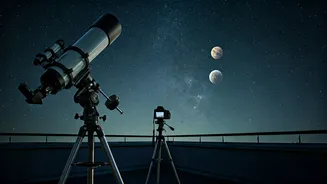
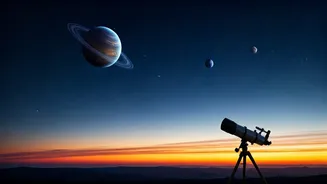
Capturing this event is rewarding. Even a smartphone can get a decent shot. First, use a tripod. Any small, portable tripod will do. This is non-negotiable for keeping your phone steady during the long exposure needed for night sky photos. Switch to your phone's 'Pro' or 'Night' mode. If you can manually adjust settings, increase the exposure time or shutter speed to a few seconds (e.g., 2-10 seconds) and set the ISO between 400 and 800. Tap on a planet to set the focus. For those with a DSLR or mirrorless camera, the possibilities expand. Use a wide-angle lens (14-35mm) to capture the planets along with some of the landscape. Mount your camera on a sturdy tripod. Set your focus to infinity manually. A good starting point for your settings is a wide aperture (like f/2.8 or f/4), an ISO of 800-1600, and a shutter speed between 5 and 15 seconds. Take a test shot and adjust your settings until the planets are bright and sharp without being washed out.