
A Flawless Touchdown for 'Pushpak'
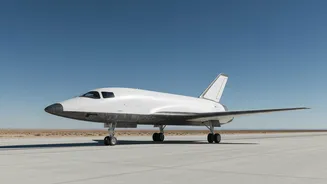
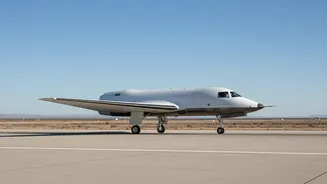
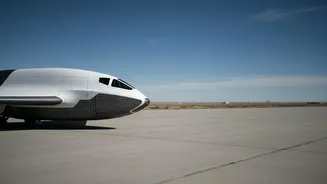
The Indian Space Research Organisation (ISRO) has once again demonstrated its prowess by successfully completing the third and final Landing Experiment (LEX-03) of its Reusable Launch Vehicle (RLV) program. The winged vehicle, aptly named 'Pushpak', executed
a perfect autonomous landing at Aeronautical Test Range in Chitradurga, Karnataka. In this latest test, Pushpak was lifted to an altitude of 4.5 km by an Indian Air Force Chinook helicopter and released. From there, it navigated its own way to the runway, autonomously correcting its course and performing a precise, high-speed horizontal landing at over 320 kmph. This successful trial, conducted under more challenging conditions than previous tests, confirms ISRO's mastery over the complex technologies required for a space vehicle to return from orbit and land like an aircraft.
The Technology of Reusability
So, what exactly is a Reusable Launch Vehicle? Think of it like a commercial airliner. It would be incredibly expensive if an airplane was discarded after just one flight. For decades, space travel has operated on this expensive, single-use model. ISRO's RLV, or 'Pushpak', is designed to change this paradigm. It's a winged space plane that, in its final form, will launch vertically like a rocket, deploy a satellite into orbit, and then fly back to Earth, landing horizontally on a runway. This allows the most expensive parts of the launch system to be refurbished and reused for multiple missions, drastically cutting down the overall cost. The recent series of landing experiments (LEX) were designed to perfect the crucial final phase of the mission: the autonomous landing.
The Economic Imperative: Slashing Launch Costs
The primary goal behind the RLV program is economic. Access to space is prohibitively expensive, with costs often cited at thousands of dollars per kilogram of payload sent to orbit. ISRO aims to slash this cost significantly, potentially by a factor of ten, by making its launch vehicles reusable. Reducing the cost from the current estimates to a fraction of that would make India an even more competitive player in the lucrative global satellite launch market. Cheaper launch services would not only attract international customers but also make space more accessible for domestic applications, including telecommunications, earth observation, and scientific research. This cost-effectiveness is the key to unlocking a new space economy and ensuring India's 'Aatmanirbhar' (self-reliant) journey in space technology.
India Joins an Elite Club
With the success of the 'Pushpak' landing tests, India has solidified its position in an elite group of space-faring nations developing reusable vehicle technology. While private companies like SpaceX have famously demonstrated booster reusability with vertical landings, ISRO's approach with a winged body and horizontal runway landing is a different, though equally complex, technological path. This achievement is the culmination of years of dedicated research and a step-by-step approach, starting with the Hypersonic Flight Experiment (HEX) in 2016 and now concluding the critical landing experiments. It validates India's indigenous capabilities in autonomous navigation, guidance, and control systems, proving that ISRO can develop and master highly sophisticated aerospace technologies.
What Lies Ahead for the RLV Program?
While the successful landing experiments are a monumental achievement, they are a crucial milestone, not the final destination. These tests, known as the RLV-LEX series, have validated the vehicle's ability to land autonomously. The next logical and more challenging phase for ISRO will be the Orbital Re-entry Vehicle (ORV) mission. This will involve scaling up the vehicle, launching it into orbit, and having it successfully re-enter Earth's atmosphere at hypersonic speeds before performing a similar autonomous landing. This will test the vehicle's thermal protection systems and its ability to withstand the extreme conditions of re-entry. The journey is long, but with each successful test, ISRO moves one step closer to its goal of a fully operational Two-Stage-to-Orbit (TSTO) reusable launch vehicle.