


Meet the 'Warm Neptunes'
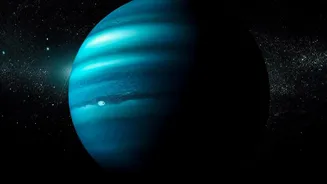
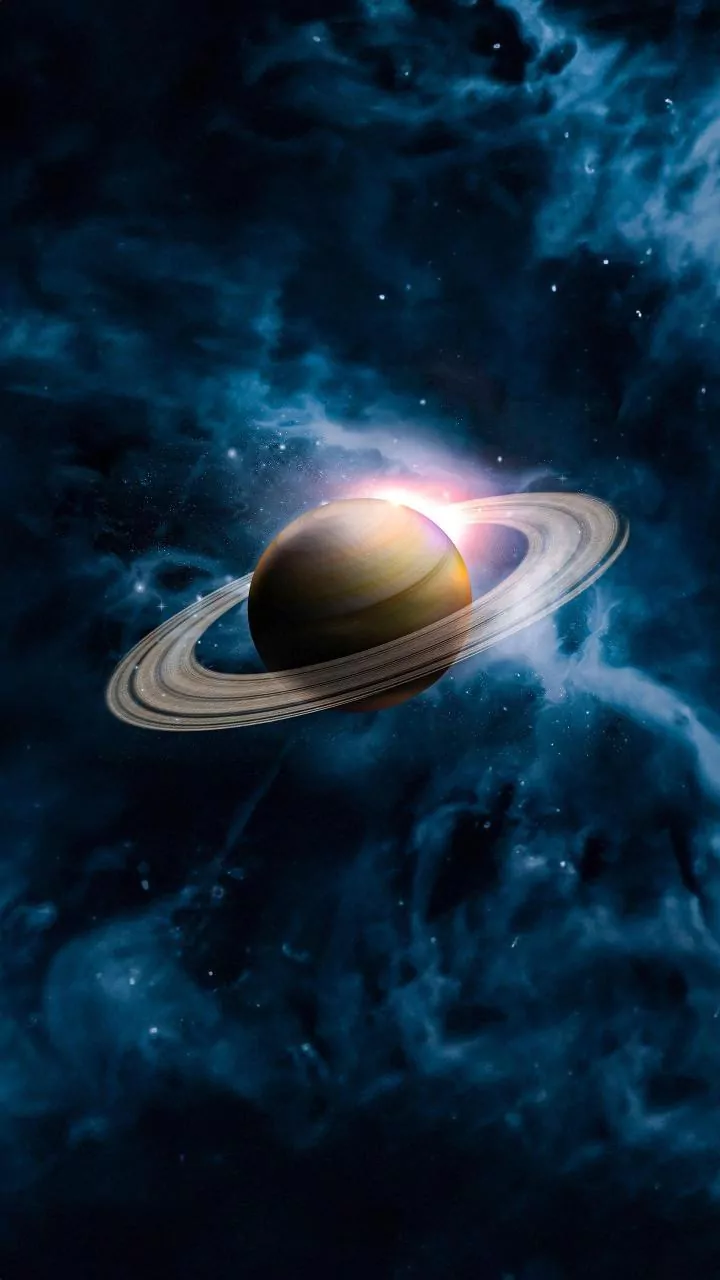
Imagine a planet roughly the size of Neptune or Uranus. Now, move it much closer to its star, cranking up the heat. That's a 'warm Neptune'. These exoplanets are a common type in our galaxy, yet they represent a class of world entirely absent from our own
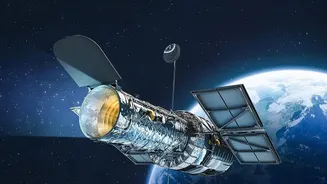
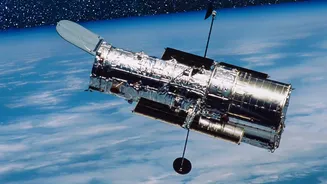
solar system. They are gas giants, composed mostly of hydrogen and helium, but their proximity to their star makes their atmospheres intriguing laboratories for planetary science. For a long time, studying their atmospheres in detail was challenging. But with the incredible power of new instruments like the James Webb Space Telescope (JWST), we can now peer into the skies of these worlds, located hundreds of light-years away.
Reading an Alien Atmosphere
So, how do you analyse the air of a planet you can't possibly visit? Scientists use a brilliant technique called transmission spectroscopy. When an exoplanet passes in front of its host star from our point of view—an event called a 'transit'—a tiny fraction of the starlight filters through the planet's atmosphere. Different molecules in that atmosphere absorb specific colours, or wavelengths, of light. By looking at which colours are missing from the starlight after it passes through, astronomers can determine what gases are present. It’s like deciphering a chemical barcode written in light. Recent observations of planets like WASP-107 b and K2-18 b using the JWST have successfully used this method to find the clear signature of methane, a molecule scientists have long been hunting for in distant worlds.
Methane: A Tantalising Clue
Why all the excitement about methane? On Earth, the vast majority of methane in our atmosphere is produced by living organisms—from microbes in wetlands to cows in fields. Because it breaks down relatively quickly when exposed to starlight, its continued presence in an atmosphere implies it's being constantly replenished. This makes it a potential 'biosignature', a tantalising hint of biological activity. However, and this is a crucial point, methane is not definitive proof of life. It can also be produced by non-biological, or 'abiotic', processes. Geological activity, like underwater volcanic vents or reactions involving water and rock (a process called serpentinization), can also release methane into an atmosphere. So, finding methane is like finding a footprint in the sand; it’s a sign something was there, but you need more information to know if it was a bird or a person.
A Stepping Stone, Not the Destination
The true significance of finding methane on warm Neptunes isn't about claiming we've found alien life on these gas giants. In fact, life as we know it is considered highly unlikely on such worlds. The real breakthrough is the proof of concept. These detections demonstrate that our technology, led by the JWST, is sensitive enough to find key molecules in exoplanet atmospheres. It's a critical stress test that our methods and instruments have passed with flying colours. Before these detections, methane had been surprisingly elusive, leading scientists to wonder if it was being depleted by unknown processes. Now we know we can find it. This success on 'easier' targets like large, puffy warm Neptunes builds the confidence and refines the techniques needed for the ultimate goal: analysing the atmospheres of smaller, rocky, Earth-like planets where the conditions for life might actually exist.
What's Next in the Cosmic Search?
Finding methane is just the first step. To build a stronger case for a potential biosignature, scientists need to see the full context. They'll look for what other gases are present alongside methane. For example, finding abundant methane and carbon dioxide together, but very little carbon monoxide, would be more suggestive of biology, because known abiotic processes struggle to create that specific chemical imbalance. Future observations will focus on taking a complete inventory of these planetary atmospheres. Each detection on a warm Neptune helps astronomers build better models of planetary atmospheres and evolution, allowing them to distinguish a truly life-bearing world from a geological mimic. By comparing the atmospheric makeup of different planets, we can begin to understand the rules of planet formation across the galaxy.