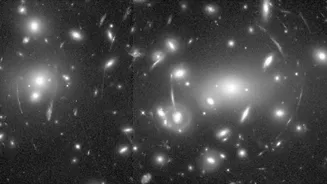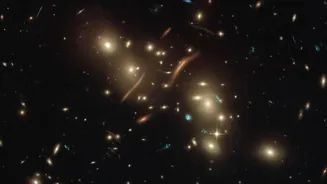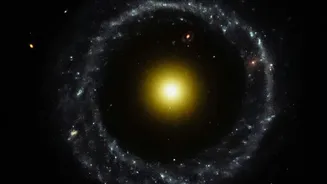



For decades, we’ve been told the universe is 13.8 billion years old. But recent discoveries have created a puzzle: galaxies that seem too mature for their age. Now, a provocative theory suggests a radical solution: the universe is much older.
Our Universe's Standard Story
The current,
widely accepted story of our cosmos is called the Lambda-CDM model. It’s the foundation of modern cosmology and tells us that the universe began with the Big Bang approximately 13.8 billion years ago. This age is calculated by measuring the expansion of the universe, primarily through the redshift of light from distant galaxies. As the universe expands, the light traveling through it gets stretched, shifting towards the red end of the spectrum. By observing this redshift and the faint, afterglow of the Big Bang, called the cosmic microwave background, scientists have built a consistent picture of our cosmic history. This model also relies on two mysterious ingredients: dark matter, which provides the extra gravity to hold galaxies together, and dark energy, which drives the universe's accelerating expansion.
A Wrinkle in Cosmic Time
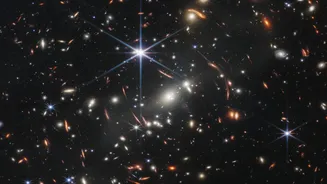
The powerful James Webb Space Telescope (JWST) was designed to peer into the universe's infancy. In doing so, it has created a fascinating problem. JWST has spotted galaxies that appear surprisingly massive, structured, and chemically mature just a few hundred million years after the Big Bang. Under the standard 13.8-billion-year timeline, these 'impossible early galaxies' shouldn't have had enough time to grow so sophisticated. It's like finding a fully grown oak tree in a forest that was supposedly planted only a year ago. This discrepancy has prompted some scientists to question whether a key part of our cosmic story might be wrong.
A Radically Older Cosmos Proposed
Enter Rajendra Gupta, an adjunct professor of physics at the University of Ottawa. He proposes a new model that dramatically revises the age of the universe, suggesting it is actually 26.7 billion years old—nearly twice the current estimate. This extended timeline offers a simple solution to the 'impossible galaxy' problem: if the universe is older, these early galaxies had billions of extra years to develop. Under this model, a galaxy observed during what was thought to be the cosmic dawn (about 300 million years post-Big Bang) would have actually existed when the universe was already 4.6 billion years old, providing ample time for it to mature.
Rewriting the Rules of Light and Gravity
Gupta's model, known as CCC+TL, is a hybrid. It merges the idea of an expanding universe with two other concepts. The first is 'Covarying Coupling Constants' (CCC), which suggests that the fundamental forces of nature might change over time. The second is a revived version of a century-old idea called 'Tired Light' (TL). Originally proposed by Fritz Zwicky in 1929, tired light theory suggests that photons lose energy as they travel across vast cosmic distances, which contributes to their redshift. By combining these ideas, Gupta argues that the effects we attribute to dark matter and dark energy might instead be explained by these evolving physical laws, potentially removing the need for these mysterious substances altogether.
The Ongoing Scientific Debate
It is crucial to understand that Gupta's theory is a challenge to a very successful and well-established model. The 'tired light' hypothesis, in its original form, was largely dismissed because it couldn't explain key observations like the blurring of distant objects or the time dilation seen in exploding stars. Gupta's hybrid model aims to overcome these past failures, and his recent papers show that CCC+TL can align with several major cosmological observations, such as the rotation of galaxies, without invoking dark matter. However, it remains a fringe topic and has yet to convince the broader scientific community. Most cosmologists believe the standard Lambda-CDM model, despite its puzzles, still provides the most comprehensive explanation for the universe we observe.