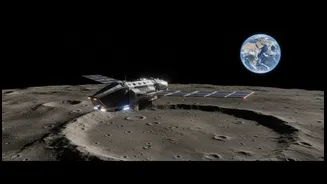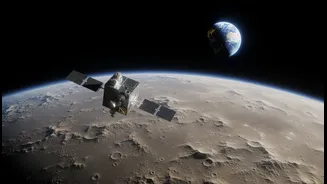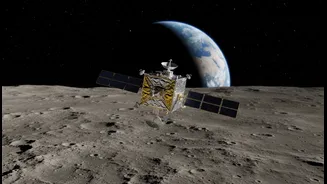






What Exactly Is CAPSTONE?
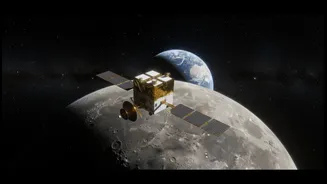
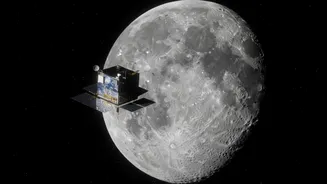
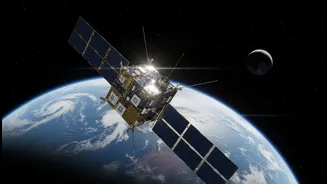
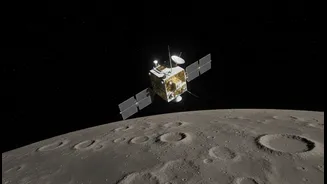
CAPSTONE, short for Cislunar Autonomous Positioning System Technology Operations and Navigation Experiment, is a 55-pound (25 kg) spacecraft that launched in June 2022. Its primary job was to be a trailblazer, testing a unique and highly efficient path
around the Moon. Developed in partnership with commercial companies like Advanced Space and Terran Orbital, CAPSTONE is a prime example of a new, cost-effective approach to space exploration. Instead of a massive, multi-billion dollar probe, this small but mighty satellite was designed to prove that big things can come in small packages, reducing risks for the more complex and expensive human-led missions to follow.
The 'Highway in Space' It's Testing
The key to CAPSTONE's mission is its orbit, known as a near-rectilinear halo orbit (NRHO). Think of it as a special, stretched-out egg-shaped path that balances perfectly between the gravity of the Earth and the Moon. This stability means spacecraft in this orbit need very little fuel to stay on course, making it ideal for long-term missions. The NRHO brings a spacecraft close to one of the Moon's poles before swinging it far out, completing one full loop in about a week. CAPSTONE was the very first spacecraft to fly in this special orbit, successfully demonstrating that NASA's models were correct and that this path is viable for future missions. This was critical for the planned Lunar Gateway space station, which was intended to use this exact orbit.
Overcoming Challenges to Make History
The journey wasn't without its nail-biting moments. Shortly after launch, the mission team temporarily lost contact with the spacecraft. Later, it experienced a propulsion issue that sent it tumbling. However, engineers on the ground worked tirelessly to solve these problems, showcasing remarkable resilience. CAPSTONE successfully entered its target orbit in November 2022 and quickly began its work. It not only completed its primary six-month mission but was extended for another 15 months to conduct further experiments. NASA officially concluded its activities with the spacecraft in June 2026, after it had achieved all of its primary and extended goals.
The Service: What CAPSTONE Did for Us
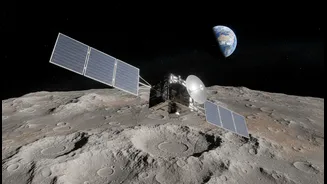
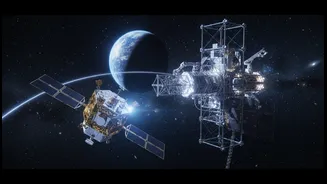
So, what's the reader-service angle? CAPSTONE's greatest service is risk reduction. By successfully charting the NRHO, it has made the path to the Moon safer and more predictable for the upcoming Artemis missions. This directly benefits future lunar exploration, in which nations like India are also major participants. Furthermore, CAPSTONE tested a groundbreaking autonomous navigation system, called CAPS, which allows spacecraft to determine their position without constant contact with Earth. It did this by communicating with NASA's Lunar Reconnaissance Orbiter, a kind of GPS for the Moon. This technology is crucial for a future where dozens of government and commercial missions are operating around the Moon simultaneously. The mission also proved that a small, relatively affordable commercial satellite can perform complex deep-space operations, opening the door for more innovation.
A Stepping Stone for Humanity's Return
While NASA has shifted its immediate strategy away from the Lunar Gateway, the data and experience from CAPSTONE remain invaluable. The mission has provided a wealth of information on navigating and operating in this unique lunar environment. The technologies it tested, from autonomous navigation to delay-tolerant networking, are essential for creating a sustainable human and robotic presence on and around the Moon. The mission has transformed from a simple pathfinder into a flexible in-orbit testbed, with its owner, Advanced Space, continuing to use the spacecraft. CAPSTONE's success story is not just about one satellite; it's about building a reliable and efficient infrastructure for the next generation of space exploration, making ventures to the Moon more accessible for all.