
A Flood of Lunar Data
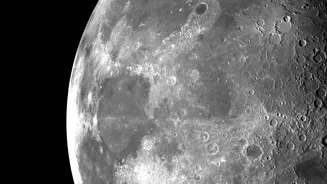
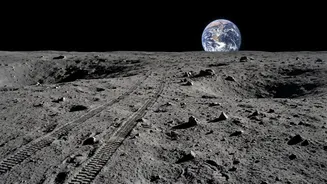
For over 17 years, NASA's Lunar Reconnaissance Orbiter (LRO) has been circling the Moon, capturing a nearly seamless, high-resolution map of its entire surface. The data sent back by LRO alone is larger than the data from all other NASA planetary missions
combined, creating a treasure trove for scientists. But it's also a classic case of having too much of a good thing. Manually sifting through these petabytes of information—millions of images and sensor readings—is an impossibly slow and labor-intensive task. This data deluge has been a significant barrier, limiting the speed at which researchers can make new discoveries. The challenge isn't collecting the data; it's making sense of it all in a timely fashion.
NASA's New Digital Geologist
To solve this problem, NASA has partnered with IBM to develop the Lunar Foundation Model. Announced in September 2026, this powerful AI is not just another specialized tool. It's a "foundation model," meaning it has been pre-trained on a vast and diverse dataset, allowing it to be adapted for many different scientific tasks without starting from scratch. It was trained on roughly two million image tiles from the LRO and other missions, including Japan's SELENE orbiter. This allows the model to find hidden connections between different types of data, such as high-resolution imagery and terrain elevation maps. By making the model open-source and publicly available, NASA and IBM are giving scientists worldwide a shared, powerful platform to accelerate lunar science.
The Search for Essential Resources
One of the most critical goals for future lunar exploration is finding water ice. Believed to be trapped in permanently shadowed regions (PSRs) at the Moon's poles, water ice is a game-changing resource. It can be converted into drinking water and breathable oxygen for astronauts, and its components—hydrogen and oxygen—can be used to make rocket fuel. This would make a long-term human presence on the Moon far more sustainable. These shadowed regions are incredibly difficult to observe, but the new AI model excels at this task. By integrating data on terrain, temperature, and illumination, it can predict where ice is most likely to be stable, significantly narrowing the search area for future robotic and human missions.
Mapping Hazards and History
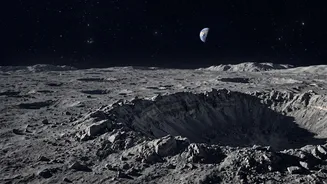
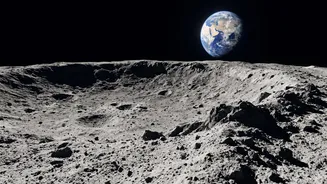
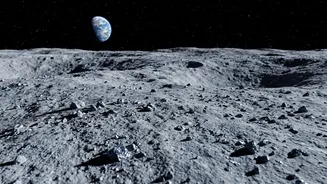
The Moon's surface is a historical record of the solar system, written in craters. Each impact tells a story, and by counting and measuring them, scientists can determine the age of different surface areas. The NASA-IBM model can automate this crater-mapping process with remarkable efficiency and accuracy. This has a dual purpose. First, it helps reconstruct the Moon's geological history. Second, and just as important, it provides a detailed hazard map for planning safe landing sites for future Artemis missions. The model is so precise that it can even detect new changes; in a test, it successfully identified a fresh crater formed by the impact of a discarded SpaceX rocket body, demonstrating its ability to monitor the lunar surface in near-real-time.
Revisiting the Moon's Volcanic Past
Scientists have long believed the Moon to be a geologically dead world, but some features challenge that assumption. So-called "irregular mare patches" are unusual volcanic formations that appear to be relatively young. Their existence suggests that the Moon's volcanic activity may have continued for longer than previously thought, forcing a rewrite of lunar thermal history. These patches are subtle and can be hard to spot, but they are another area where the AI model shines. It can scan vast areas and flag these geological oddities for further investigation by human experts. By accelerating the discovery and mapping of these features, the AI is helping scientists piece together a more accurate understanding of how the Moon cooled and evolved over billions of years.