
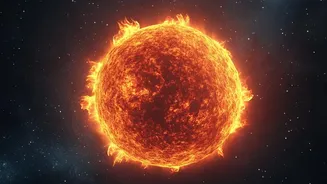

The Sun's Greatest Mystery
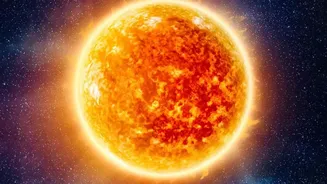
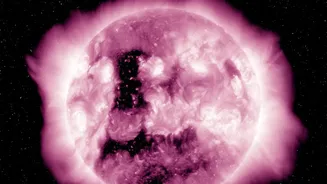
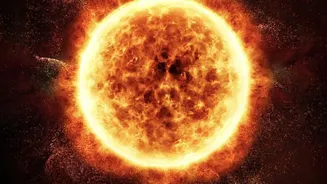
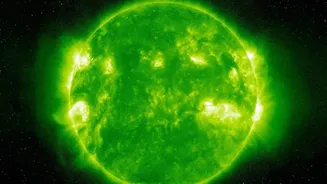
For nearly a century, solar physicists have been puzzled by one of our star’s most counterintuitive features: the coronal heating problem. The sun's visible surface, called the photosphere, sizzles at about 6,000 degrees Celsius. Yet, its ethereal outer
atmosphere, the corona, reaches a staggering 2 million degrees Celsius. This is like the air around a bonfire being hundreds of times hotter than the fire itself. Scientists have long theorized that energy must be actively transported from the sun’s turbulent surface up into the corona to explain this intense heat. The prevailing theories have pointed to two main suspects: magnetic reconnection, where magnetic field lines snap and release energy, and the dissipation of powerful magnetic waves. But getting direct proof has been incredibly difficult.
A Breakthrough Observation
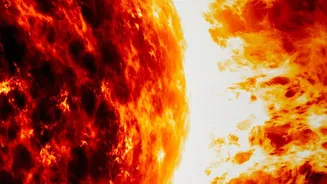
Recent findings, particularly from the world's most powerful solar telescope, the Daniel K. Inouye Solar Telescope in Hawaii, have offered a breakthrough. Astronomers have for the first time directly observed tiny, swirling plasma vortices on the sun's surface. These patterns are the result of a phenomenon well-known in fluid dynamics called the Kelvin-Helmholtz instability (KHI). This instability occurs when two fluids of different speeds flow past each other, creating a shear that grows into wave-like vortices—a process you might see in curling clouds or waves on the ocean. On the sun, this happens at the edges of 'granules'—vast, bubbling cells of rising and sinking hot gas that cover the surface. These newly seen vortices are a visible sign of powerful underlying processes.
Riding the Magnetic Waves
The discovery of these vortices provides a crucial link to another type of wave: Alfvén waves. First predicted in the 1940s, Alfvén waves are magnetic disturbances that travel through plasma. Scientists have long suspected that a small, twisting version of these waves, called torsional Alfvén waves, could be constantly carrying energy from the surface into the corona. These waves twist the sun's magnetic field lines like a corkscrew, but their motion is so subtle they were impossible to see directly until now. The new high-resolution observations reveal the tell-tale signs of these twisting motions, confirming they are present and providing a mechanism for how energy from the churning surface gets injected into the atmosphere. The Kelvin-Helmholtz vortices seem to be a key part of how this energy transfer is initiated, twisting the magnetic field lines like a coiled spring and releasing that energy upward.
Connecting Waves to Heat
Observing the waves is one thing; proving they deliver the heat is another. This is where multiple spacecraft have provided the smoking gun. In a fortunate alignment, NASA's Parker Solar Probe and the European Space Agency's Solar Orbiter flew through the same stream of solar wind at different distances from the sun. The Parker probe, closer to the sun, detected strong Alfvén waves within the plasma. Days later, when the Solar Orbiter intercepted the same plasma stream further out, the waves had dissipated, but the plasma itself was three times hotter and moving faster than it should have been. The amount of energy lost by the waves perfectly matched the increase in the plasma's heat and speed, providing the first direct evidence that the dissipation of these waves is what heats and accelerates the solar wind.
Why Solving This Puzzle Matters
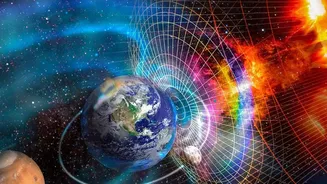
Understanding how the corona is heated isn't just an academic exercise. The corona is the source of the solar wind, a constant stream of charged particles that flows past Earth. Violent solar events like flares and coronal mass ejections originate in this superheated atmosphere, sending massive bursts of energy and particles into space. These space weather events can disrupt our satellites, endanger astronauts, and even knock out power grids on the ground. By finally piecing together how energy travels through the sun's atmosphere, scientists can build more accurate models to forecast this solar activity. This breakthrough represents a major step toward creating a reliable 'space weather forecast,' helping to protect our increasingly technology-dependent world.