


The Inevitable End of the Line
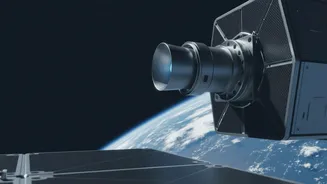
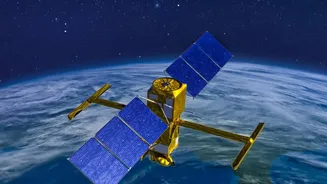
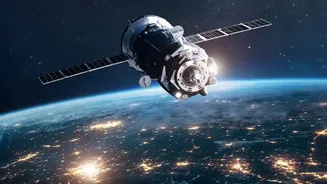
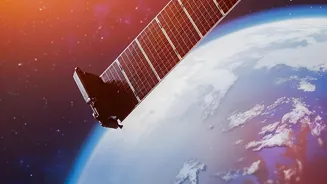
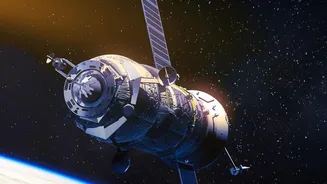
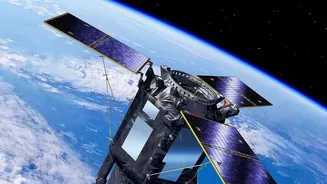
Satellites in Low-Earth Orbit (LEO), which are crucial for everything from high-speed internet to detailed Earth observation, face a constant battle with atmospheric drag. Even at altitudes of a few hundred kilometres, there are enough residual gas molecules
to slow a satellite down, causing its orbit to gradually decay. To counteract this, satellites must periodically fire their onboard thrusters. The problem is that they can only carry a limited supply of propellant, like xenon gas. Once the tank is empty, the mission is effectively over, and the satellite eventually falls back to Earth, burning up in the atmosphere. This fundamental limitation not only dictates the operational lifespan and cost of missions but also contributes to the growing problem of space debris as defunct satellites become uncontrollable.
How to 'Breathe' in Space
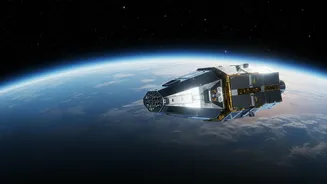
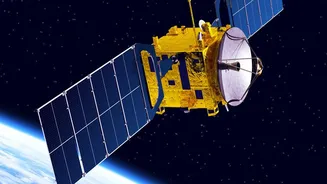
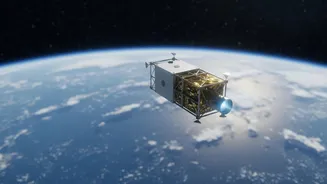
Air-breathing electric propulsion, or ABEP, offers a paradigm-shifting solution. The concept is elegantly simple: instead of carrying its own fuel, the satellite uses what's already there. An ABEP system consists of two main components: a special intake and an electric thruster. As the satellite speeds through the upper atmosphere at around 7.8 km/s, the intake is designed to passively collect the sparse air molecules, primarily nitrogen and corrosive atomic oxygen. Instead of these particles simply bouncing off and creating drag, they are channelled and compressed. Inside the thruster, these collected gases are ionized—given an electric charge—and then accelerated by electromagnetic fields before being expelled at high velocity. This creates thrust, precisely counteracting the atmospheric drag and allowing the satellite to maintain its orbit indefinitely, powered only by its solar arrays.
A New Frontier: The VLEO Advantage
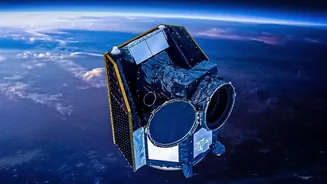
This technology could unlock a whole new region for satellite operations: Very Low-Earth Orbit (VLEO), typically between 120 and 250 kilometres up. Operating at these lower altitudes offers significant advantages. For Earth observation and surveillance missions, it means higher-resolution images. For communications constellations, it means lower latency, resulting in faster data transmission. Until now, VLEO has been impractical for long-term missions because the denser atmosphere creates too much drag, rapidly depleting a satellite's conventional fuel supply. Air-breathing propulsion turns this disadvantage on its head, using the increased atmospheric density as a more plentiful source of propellant. This would enable persistent, high-performance missions in an orbital region that has been largely inaccessible.
Pioneers and Prototypes
The idea of air-scooping propulsion has existed since the 1960s, but only in the last decade has it moved from theory to reality, with significant research funded by organizations like the European Space Agency (ESA). In 2018, an ESA-led team successfully conducted the world's first on-ground firing of a prototype RAM-EP (Ram-Electric Propulsion) thruster. This test proved that the system could capture atmospheric particles and use them to generate thrust. Various research projects across Europe, Japan, and the UK are continuing to refine the designs for both the crucial air intake and the hyper-efficient electric thrusters needed to make the system viable in space. As recently as March 2026, a key design review for an ESA project marked another milestone, moving the concept closer to an integrated system ready for in-orbit demonstration.
Challenges on the Horizon
Despite its immense promise, air-breathing propulsion is not without significant technical hurdles. The primary challenge is efficiency. At VLEO altitudes, the atmosphere is incredibly rarefied, so the intake system must be exceptionally good at collecting molecules. The thruster must also be able to efficiently ionize and accelerate a mix of different gases, unlike conventional thrusters optimized for a single propellant like xenon. Furthermore, the atomic oxygen prevalent at these altitudes is highly corrosive, which poses a long-term durability challenge for the materials used in the intake and the satellite itself. Overcoming these issues to create a system that is robust, reliable, and powerful enough to consistently counteract drag is the final frontier for this technology before it can be widely deployed.