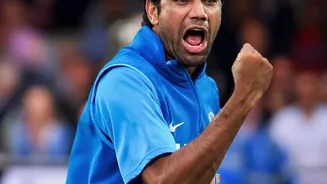





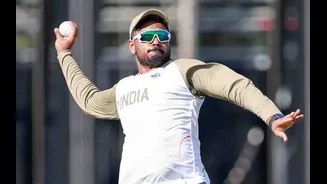
Before he was the canny, reliable seamer of India’s 2011 World Cup-winning squad, Munaf Patel was something else entirely: a raw, ferocious pace sensation from a tiny village, hailed as the fastest bowler in the country.
A Diamond in the Rough
The Munaf Patel story begins in Ikhar,
a small village in Gujarat, far from the structured academies that produce most modern cricketers. He was a rustic talent, working in a tile factory for a meagre monthly salary before his life changed. His journey to the national stage was almost mythical. He was first spotted by former Indian selector Kiran More, who saw a spark in the young man bowling in rubber slippers. More immediately recognised his potential, noting he was 'genuinely quick' and 'special talent', and sent him to the MRF Pace Foundation in Chennai. There, under the watchful eyes of Australian pace legend Dennis Lillee, the hype began to build. Lillee and visiting Australian captain Steve Waugh were astonished by his raw pace, with some deliveries reportedly touching 150 kmph.
The Promise of Express Pace
In an era when India was desperate for a genuine fast bowler, Munaf was the answer to a nationwide prayer. With backing from Sachin Tendulkar, he was fast-tracked into the Mumbai domestic side. The excitement was palpable. He made his Test debut against England in Mohali in March 2006 and made an immediate impact, taking seven wickets for 97 runs. It was one of the best debuts by an Indian fast bowler, and he was lauded for his ability to swing the ball at high speed. On the subsequent tour of the West Indies, he consistently bowled at speeds over 140 kmph, cementing his reputation as India's quickest bowler. The dream, it seemed, had arrived.
The Painful Transformation
The dream of sustained, fiery pace was short-lived. The rigours of international cricket and bowling on unresponsive Indian pitches took a heavy toll on his body. A series of recurring injuries forced a difficult choice: persist with express pace and risk a career cut short, or adapt to survive. Munaf chose survival. He deliberately cut down his pace, focusing instead on line, length, and cutters. West Indian great Andy Roberts wryly commented that the pacer who arrived in the Caribbean in 2006 with speed was now 'spinning the ball' a few years later. This new version of Munaf was less exciting and often criticised, but the transformation would prove crucial for his career's most significant chapter.
The Unsung World Cup Hero
Munaf's entry into the 2011 World Cup squad was almost an accident, as he came in as a replacement for an injured Praveen Kumar. By then, he was no longer the tearaway pacer but a shrewd, economical seamer. Throughout the tournament, he was M.S. Dhoni's reliable workhorse. He played in eight matches and became India's third-highest wicket-taker with 11 wickets, behind only Zaheer Khan and Yuvraj Singh. His most vital contribution came in the high-pressure final against Sri Lanka. While other bowlers were expensive, Munaf bowled a tight spell, conceding just 41 runs in nine overs. He took no wickets in that spell, which is perhaps why it's often forgotten. However, his control and economy were instrumental in containing Sri Lanka and setting the stage for India's historic victory.