


The Search for Cosmic Clues
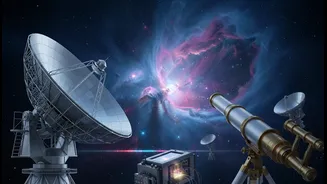
Astrobiology, the field dedicated to searching for life in the universe, is no longer the stuff of pure science fiction. With powerful new telescopes and sophisticated robotic explorers, scientists are actively hunting for “biosignatures.” A biosignature is any
sign of life, past or present. This could be a gas in a planet’s atmosphere that is typically produced by living organisms, like oxygen, or complex organic molecules found in a meteorite or soil sample. It could even be a fossilized microbe trapped in ancient rock on Mars. The goal is to find that one unambiguous signal from the cosmos that says, “We are not alone.” The challenge, however, is that nature is a master of mimicry, and not every tantalizing clue points to life.
The Danger of 'False Positives'
The biggest hurdle in astrobiology is the problem of “false positives”—phenomena that look like signs of life but are actually caused by simple geology or chemistry. For instance, scientists once thought that finding abundant oxygen in an exoplanet’s atmosphere would be a slam-dunk indicator of photosynthesis. Now, we know that intense starlight can break down water molecules, releasing oxygen abiotically, with no life involved. Similarly, the methane detected in Mars’ atmosphere could be produced by microbes, but it could also be the result of geological processes involving water and rock. History provides a great cautionary tale: in 1996, scientists announced they might have found fossilized microbes in a Martian meteorite, ALH84001. While initial evidence was exciting, further analysis showed that non-biological processes could have created the same structures. These experiences have taught the scientific community a crucial lesson: a single piece of evidence is never enough.
The Power of a Second Opinion
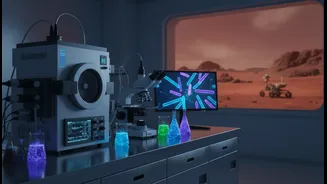
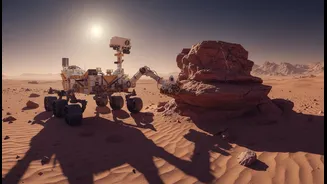
This is where the principle of “converging evidence from independent measurements” becomes critical. Think of it like a detective building a court case. A single eyewitness is compelling, but their testimony alone is not enough for a conviction. A strong case requires multiple lines of evidence—fingerprints, DNA, security footage, and a motive—that all independently point to the same conclusion. In astrobiology, this means not relying on a single instrument or detection method. If one instrument on a Mars rover detects methane, the claim becomes much stronger if a separate instrument measures a corresponding decrease in another chemical that microbes would consume. Better still is when an orbiting spacecraft confirms the ground-based reading. This cross-verification between different tools and methods helps rule out instrument error and non-biological explanations, building a more robust and believable case.
Building a Framework for Certainty
To standardize this rigorous approach, NASA scientists have developed frameworks like the “Confidence of Life Detection” (CoLD) scale. This seven-level scale is designed to manage expectations and ensure that claims of life are vetted properly. Level 1 might be the initial detection of a potentially interesting signal. To move up the ladder, scientists must rule out contamination from Earth (Level 2), show that the environment could actually support life (Level 3), and get repeat detections with different instruments or methods (Levels 4 and 5). Reaching the highest levels, 6 and 7, requires confirming additional, independent biosignatures that, when taken together, point definitively to a biological origin. This approach reframes the search for life not as a single “eureka!” moment, but as a patient, progressive process of building confidence and eliminating doubt.