







The Old Model Is Breaking
For decades, the mentorship model was simple and effective. An experienced senior would take a junior employee under their wing, teaching them the specific hard skills needed to excel in a particular role. This worked perfectly when everyone was in the same
office, navigating the same physical hallways and attending the same team meetings. Learning was often a process of osmosis, supplemented by direct instruction. The mentor was a master of a specific domain, and their primary job was to create a clone of their expertise. However, the shift to hybrid and remote work has fundamentally broken this model. When team members are geographically dispersed, the informal learning that happens by the water cooler vanishes. More importantly, visibility across the organisation shrinks dramatically. An employee might become a star within their own team but remain completely unknown to other departments, limiting their opportunities for growth, collaboration, and internal mobility.
The Danger of Digital Silos
In a physical office, you might bump into someone from marketing in the cafeteria or strike up a conversation with an engineer from another project. These casual interactions build what experts call 'social capital'—a network of relationships that fosters trust and facilitates the flow of information. In a digital-first environment, these interactions don't happen by accident. Communication becomes highly structured, confined to scheduled video calls and team-specific Slack channels. This creates digital silos, where teams operate in near-total isolation. An employee mentored only in the 'old way' learns their specific job functions exceptionally well but has no understanding of how their work impacts the finance department or what challenges the product team is facing. They become a highly-specialised cog in a machine they cannot see, which is a significant career risk in an era that values adaptability and cross-functional problem-solving.
Enter the Mentor as a 'Network Weaver'
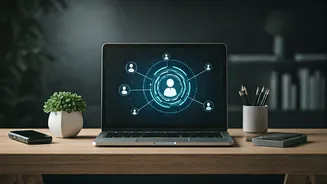
This is where the modern hybrid mentor comes in. Their value isn't just in what they know, but in *who* they know and how they can connect their mentee to the broader organisation. Instead of just teaching a junior analyst how to build a better financial model, a hybrid mentor introduces them to the sales lead to understand revenue drivers or connects them with the data science team to explore new analytical tools. They act as a 'network weaver' or a 'bridge-builder'. Their primary function is to use digital tools to deliberately create the cross-team connections that used to happen organically. They teach their mentee how to navigate the company's digital ecosystem, how to communicate effectively with different stakeholders online, and how to build a reputation beyond their immediate team. This moves mentorship from a purely instructional role to a strategic one focused on integration and visibility.
Communication as a Career Superpower
In this new paradigm, digital cross-team communication isn't a 'soft skill'; it's a core competency. A mentor who champions this understands that an employee's long-term success depends less on mastering a single software and more on their ability to collaborate, influence, and gather information from across the business. They encourage their mentees to join cross-departmental projects, present their findings to different audiences, and proactively seek information from outside their immediate sphere. Valuing this type of communication means a mentor is equipping their mentee for leadership. Future leaders won't be the ones with the deepest technical knowledge in one area; they will be the ones who can synthesize information from multiple sources, build consensus among diverse groups, and drive projects that span the entire organisation. An isolated skill has a shelf life, but the ability to connect and communicate effectively is a timeless asset that only grows in value.