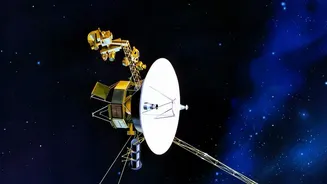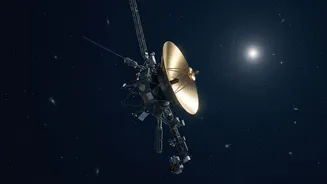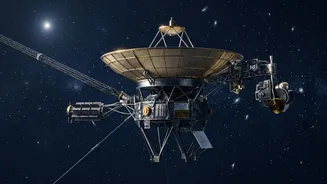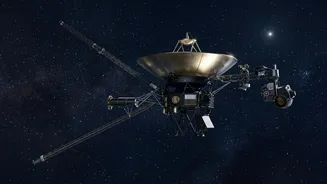

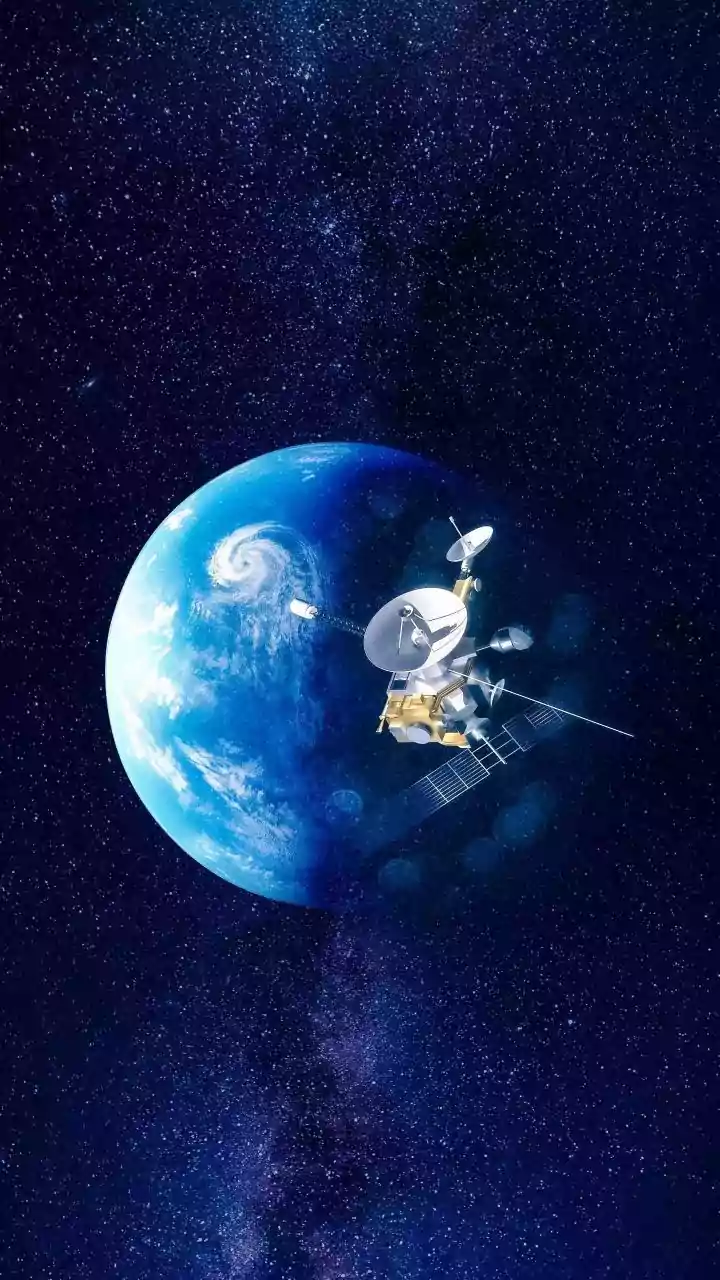
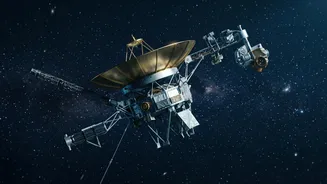
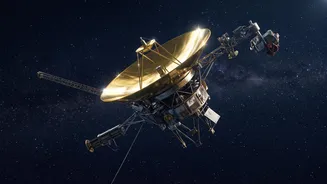
It’s lonely out in interstellar space. But for nearly 50 years, one human-made object has been our silent ambassador to the cosmos. Soon, NASA's Voyager 1 will cross a threshold no probe has ever reached: a full light-day from Earth.
A Milestone Measured in Light
On November 18, 2026,
Voyager 1 will be one light-day away from its home planet. A light-day isn't a measure of time, but of immense distance. It’s how far a particle of light travels in a vacuum in 24 hours: approximately 25.9 billion kilometres. To put that in perspective, sunlight takes about eight minutes to reach Earth, which is eight light-minutes away. A message sent to Voyager 1, travelling at the speed of light, will take a full 24 hours to arrive. Any reply the probe sends back will take another 24 hours to reach us. This 48-hour round-trip communication delay underscores the vast, almost incomprehensible distance a machine built by human hands has travelled.
A Journey Almost 50 Years in the Making
Launched on September 5, 1977, Voyager 1’s original task was the 'Grand Tour' of the outer planets. Although it launched after its twin, Voyager 2, a faster trajectory allowed it to arrive at Jupiter first in 1979, followed by Saturn in 1980. Its discoveries were revolutionary: active volcanoes on Jupiter's moon Io, the intricacies of Saturn's rings, and a thick, nitrogen-rich atmosphere on Saturn's moon Titan. After its planetary encounters, its mission shifted. In 1990, it turned its camera back one last time to capture the famous 'Pale Blue Dot' image of Earth, a tiny speck in a sunbeam. In August 2012, it officially entered interstellar space, becoming the first human-made object to leave the Sun's bubble of influence.
An Aging Explorer at the Final Frontier
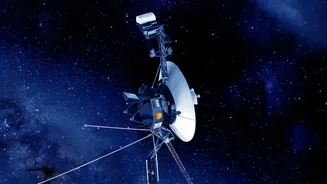
Keeping a nearly 50-year old spacecraft alive is a masterclass in engineering ingenuity. Voyager 1 is powered by three radioisotope thermoelectric generators, which convert heat from decaying plutonium into electricity. That power supply dwindles by about four watts every year. To conserve energy, NASA has been systematically shutting down instruments and heaters. Recently, in a delicate maneuver nicknamed the 'Big Bang', engineers swapped some components for lower-power alternatives to extend the life of the remaining science instruments. Today, only two instruments remain active, listening to the hum of the interstellar medium. The probe has also survived recent scares, including a 48 hour communication blackout in October 2026 that resolved itself before the ground team could even send troubleshooting commands across the light day divide.
A Message in a Cosmic Bottle
Attached to Voyager 1's side is a time capsule, a message in a bottle for any civilization that might one day find it: the Golden Record. This 12 inch, gold plated copper disk contains sounds and images selected to portray the diversity of life and culture on Earth. Curated by a committee led by astronomer Carl Sagan, it includes 116 images, natural sounds like wind and surf, greetings in 55 languages, and 90 minutes of music, from Bach and Beethoven to Chuck Berry's 'Johnny B. Goode'. It's a gesture of hope and a snapshot of humanity, now travelling silently through the space between stars.