




An Ancient Cosmic Ballroom
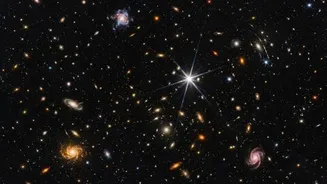
Imagine a sphere packed with hundreds of thousands of stars, all swirling in a gravitational dance. This is a globular cluster, and NGC 6397 is one of the closest and oldest, a relic from the universe's early days. Located 7,800 light-years from Earth,
its core is so dense with stars it's known as a 'core-collapsed' cluster. For years, astronomers theorized that such a dense environment would be the perfect place to find a specific type of cosmic beast: an intermediate-mass black hole (IMBH). These have long been the 'missing link' between the smaller, stellar-mass black holes formed from single stars and the supermassive giants at the hearts of galaxies. The hunt was on to prove one existed in NGC 6397's crowded core.
The Ghost in the Data
Finding a black hole is never easy; by definition, they are invisible. Scientists can only detect them by observing their gravitational influence on the objects around them. In this case, the team of astronomers, led by researchers from the Paris Institute of Astrophysics, meticulously analyzed huge datasets. They combined years of high-precision data from the Hubble Space Telescope and the Gaia space observatory, which track the tiny movements of individual stars over time. They were looking for a specific pattern: stars moving as if they were orbiting a single, heavy, central point. A point-like gravitational pull would be the tell-tale sign of a single IMBH. But the data wasn't showing what they expected. The stellar dance was more chaotic, its choreography pointing to a different director.
Not a King, But a Court
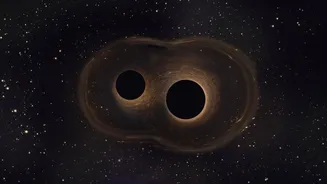
The breakthrough came when the researchers realized the invisible mass they were detecting wasn't concentrated at a single point. Instead, it was spread out over a significant portion of the cluster's core, extending to a few percent of its total size. This ruled out a lone, medium-sized black hole. The 'invisible resident' wasn't a solitary king holding court, but something else entirely. The data trail, stretching back through decades of observation, revealed the culprit: a dense swarm of smaller, stellar-mass black holes, each just a few times the mass of our sun. These dark remnants of massive stars had, over billions of years, sunk towards the cluster's center through gravitational interactions, forming a hidden collective.
A New Kind of Cosmic Object
This discovery marked the first time such a concentration of black holes had been measured in the core of a globular cluster. It was a case of scientists setting out to find one thing and discovering something far more unexpected and, arguably, more interesting. Instead of one 'missing link' black hole, they found a graveyard of dozens of smaller ones, all exerting a combined gravitational pull that mimicked a larger object. This finding forces a rewrite of the cosmic playbook on how black holes settle and evolve in these ancient, dense star systems. It suggests that the final fate of core-collapsed clusters might not be to host a single IMBH, but rather to become a repository for these dark, stellar remnants.