




The Billion-Dollar Problem of Space Logistics
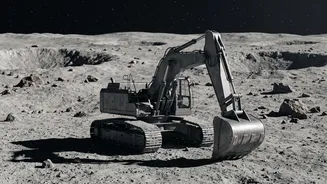
To build a sustainable base on the Moon, we need infrastructure: habitats, landing pads, and radiation shields. The problem is that every kilogram of cargo launched into space costs an immense amount of money. Transporting traditional construction materials
like steel and concrete is simply not feasible for creating a permanent settlement. This economic barrier has forced space agencies like NASA and the European Space Agency (ESA) to think outside the box, leading them to a concept known as in-situ resource utilization (ISRU). The principle is simple: if you want to live somewhere, you should use local materials. On the Moon, the most abundant resource is the ground itself.
Introducing Lunar Regolith: The Moon's Own Building Blocks
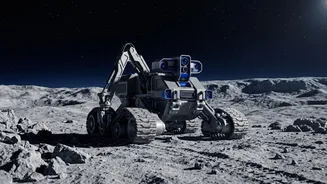
The surface of the Moon is covered in a fine, powdery layer of dust and crushed rock called regolith. Formed over billions of years by the constant bombardment of micrometeorites, this material is primarily composed of silicon dioxide, along with oxides of iron, calcium, and aluminium. While this abrasive, sharp-edged dust poses a hazard to astronauts and equipment, it also holds the key to construction. Scientists believe this lunar soil can be transformed into a durable building material, much like how sand is used to make glass or bricks on Earth. Instead of packing bricks, future missions could pack robotic builders that turn this plentiful dust into solid structures.
From Dust to Dwellings: The Magic of 3D Printing
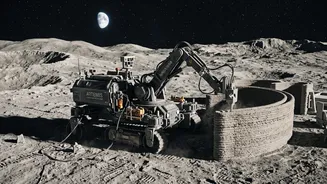
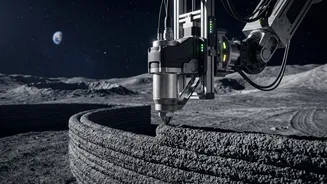
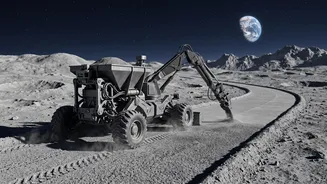
So, how do you turn loose soil into a habitat? The leading technology is large-scale 3D printing. Several methods are being explored, but many focus on a process called sintering. This involves using a focused energy source, like a powerful laser or concentrated sunlight, to heat the regolith to temperatures over 1,000 degrees Celsius. This melts the particles together, and as they cool, they fuse into a solid, ceramic-like material. Robotic 3D printers would move across the lunar surface, extruding this molten material layer by layer to build walls, domes, and other structures. Companies like ICON are developing systems for NASA that could do just that, creating strong components capable of withstanding the harsh lunar environment. ESA has also demonstrated the concept by printing 1.5-tonne building blocks from simulated moon dust.
More Than Just a Construction Site
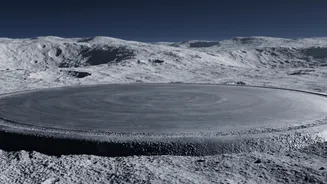
Building on the Moon involves more than just perfecting the raw materials. Any lunar habitat must protect its inhabitants from incredible dangers. The Moon has no atmosphere to shield against cosmic radiation or the constant threat of micrometeorite impacts. Temperatures are also extreme, swinging from a scorching 127°C in the day to a frigid -173°C at night. Architectural designs reflect these challenges. Many concepts, like those from the firm Foster + Partners, feature dome-like structures with cellular walls, providing strength and insulation. The structures would be built over inflatable, pressurized modules to create a safe living space for astronauts. Landing pads are another critical piece of infrastructure, as building them from sintered regolith would prevent the abrasive dust from sandblasting the area during takeoffs and landings.
Building a Future Beyond Earth
The push for lunar construction is a cornerstone of NASA’s Artemis program, which aims to establish a permanent 'Artemis Base Camp' at the Moon's South Pole by the end of the decade. This base is envisioned not just as a scientific outpost but as a stepping stone for future missions to Mars. Mastering the ability to build with local resources is fundamental to any long-term, sustainable human presence beyond Earth. For space-faring nations, including India, which became the first to land at the lunar south pole, these developments are crucial. They signal a shift from short-term exploration to long-term settlement, potentially unlocking a new lunar economy. The ability to 'live off the land' will determine the pace and scale of humanity's next giant leap.