


Imagine discovering a new world, only for it to vanish without a trace. For astronomers, this was not science fiction but a real cosmic mystery that sparked a years-long investigation into the strange case of a so-called 'missing' exoplanet.
A Landmark Discovery
The story
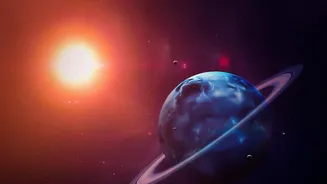
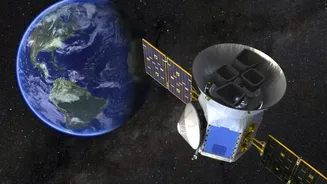
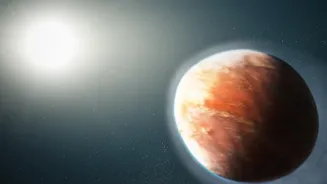
begins about 25 light-years away, with a bright young star named Fomalhaut. In the mid-2000s, astronomers using the Hubble Space Telescope announced a thrilling discovery: they had captured one of the first-ever direct images of an exoplanet, a planet outside our solar system. Named Fomalhaut b, it appeared as a distinct point of light orbiting its star. This was a huge deal. Most exoplanets are found indirectly, by detecting the slight dimming of a star as a planet passes in front of it. Seeing one directly was a triumph, offering a rare glimpse into another solar system. But from the beginning, Fomalhaut b was strange. It was incredibly bright in visible light, far brighter than a planet of its estimated size should be. Stranger still, it gave off almost no heat in the infrared spectrum, which was puzzling for a young, large planet that should still be relatively warm.
The Vanishing Act
The mystery deepened over the next several years as astronomers continued to track the object's journey around its star. Then, when a team led by astronomer András Gáspár reviewed Hubble images taken in 2014, they were met with a stunning surprise: Fomalhaut b was gone. The bright dot that had been so clearly visible just a decade earlier had completely vanished. Planets, especially massive ones thought to be several times the size of Jupiter, do not simply disappear. The finding sent shockwaves through the astronomical community. It was a cosmic 'now you see it, now you don't' that defied easy explanation. The team realised that whatever they had been observing was not behaving like a proper planet. The clues didn't add up, and it was clear that a different kind of investigation was needed to solve the case of the disappearing world.
Cosmic Detective Work
Going back through all the archived Hubble data, the astronomers started to piece together a new timeline of events. They noticed that in the images between its discovery and disappearance, the object seemed to be fading and growing more diffuse over time. This was the key clue. A solid planetary body wouldn't expand and fade away. But a cloud of dust would. This led to a bold new theory: Fomalhaut b was never a planet at all. Instead, what the Hubble telescope had first captured in 2004 was something far more fleeting and violent: the immediate aftermath of a titanic collision between two massive, icy bodies. According to the new model, two objects, each estimated to be about 200 kilometres wide, had smashed into each other shortly before the first observation.
A Ghost Made of Dust
The collision would have created a massive, expanding cloud of fine dust and ice particles. This cloud was initially compact enough to be mistaken for a single, large object. Its brightness in visible light was explained by the vast surface area of the fine dust scattering light from the central star, Fomalhaut. The lack of an infrared signature was also explained, as tiny dust particles wouldn't retain heat like a massive planet. Over the next decade, the cloud continued to expand and disperse. As the particles spread out, the cloud grew fainter and larger until, by 2014, it had dissipated so much that it was no longer detectable by Hubble. What astronomers had witnessed was not the disappearance of a planet, but the slow fading of the evidence from a cataclysmic, planet-forming event. Such collisions are believed to be a common, though rarely observed, part of how planetary systems evolve.