

Defining the 'Goldilocks' Zone
The first step in finding another Earth is knowing what to look for. Scientists focus on a concept called the "habitable zone," often nicknamed the "Goldilocks zone." This is the orbital region around a star where conditions are not too hot and not too cold,
but just right for liquid water to exist on a planet's surface. Since all known life requires liquid water, its potential presence is the most critical starting point. The size and location of this zone depend entirely on the star. Hotter, brighter stars have habitable zones that are much farther out, while smaller, cooler stars like red dwarfs have zones that are much closer in. But simply being in this zone isn't a guarantee of habitability; it's just the first and most important clue that a planet is worth a closer look.
Spotting a Planet's Shadow
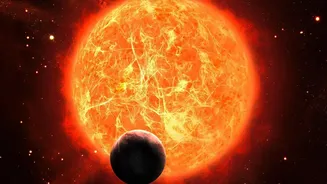
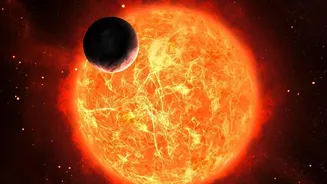
The most successful technique for finding exoplanets is the transit method. Imagine a moth flying in front of a distant streetlight, causing a tiny, brief dip in its brightness. Scientists look for the same effect with stars. When an exoplanet passes directly between its star and our telescopes, it blocks a minuscule fraction of the starlight. By observing a star continuously, powerful observatories like the Kepler Space Telescope and the Transiting Exoplanet Survey Satellite (TESS) can detect these periodic dips. The time between transits reveals the planet's orbital period, and the amount of dimming helps scientists estimate the planet's size. This method has been responsible for the vast majority of exoplanet discoveries to date.
Detecting a Star's Wobble
Another powerful technique is the radial velocity method, sometimes called the "wobble method." A planet doesn't just orbit its star; the star and planet both orbit a common center of mass. Because the star is vastly more massive, it only moves in a tiny circle or ellipse, creating a slight wobble. While we can't see this wobble directly, we can detect its effect on the star's light. As the star wobbles towards Earth, its light waves are compressed, shifting them towards the blue end of the spectrum. As it wobbles away, the light waves are stretched, shifting them towards the red. Highly sensitive instruments called spectrographs can measure these tiny, periodic color shifts, allowing astronomers to infer the presence and minimum mass of an orbiting planet.
Reading a Distant Atmosphere
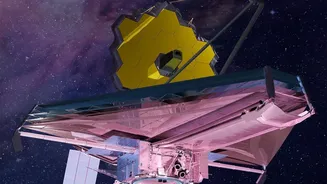
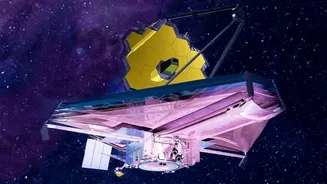
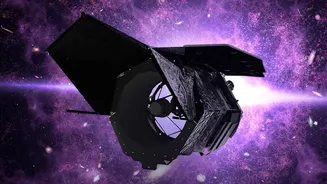
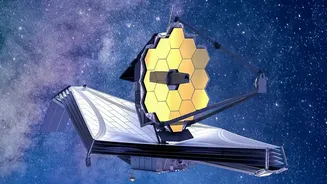
Finding a rocky planet in the habitable zone is just the beginning. The real prize is figuring out if it has an atmosphere and, if so, what it's made of. This is where advanced telescopes like the James Webb Space Telescope (JWST) come in. Using a technique called spectroscopy, scientists analyze the starlight that passes through an exoplanet's atmosphere during a transit. Different gases in the atmosphere absorb specific wavelengths of light, leaving a unique chemical fingerprint on the light that reaches the telescope. By analyzing this fingerprint, astronomers can identify key gases like water vapor, methane, and oxygen. The presence of certain combinations of gases, known as biosignatures, could be compelling evidence of biological processes. A biosignature is a substance or feature that points to the presence of life, though scientists are careful to rule out non-biological explanations.