







The Organic Challenge
For a cotton farmer, getting that coveted 'organic' label is both a lucrative goal and a massive operational headache. Organic certification requires that land be free of prohibited synthetic herbicides and pesticides for at least three years. This rule
is the bedrock of organic farming, designed to protect soil health and prevent chemical runoff. However, it presents a significant problem: how to control weeds. Weeds are relentless competitors, robbing cotton plants of essential water, sunlight, and nutrients. Unchecked, they can slash crop yields by 50% or more, directly impacting a farm's revenue. While conventional farming relies on spraying synthetic herbicides, organic farmers must find other ways to fight back.
An Uphill Battle Against Weeds
Without chemical herbicides, organic cotton farmers have traditionally relied on a combination of labour-intensive and often expensive methods. These include manual hand-weeding, where workers physically pull weeds from the fields, and mechanical cultivation, which involves tilling the soil between crop rows. Both have major drawbacks. Hand-weeding is costly and subject to labour shortages. Cultivation can be effective between rows but struggles to remove weeds growing close to the cotton plants themselves without causing damage. Some farmers also use practices like flame weeding or applying natural, OMRI-approved herbicides, but these can be less effective and costly to apply at scale. The result is an economic squeeze where the cost of weed management can eat significantly into the profits from selling premium organic cotton.
Enter the Smart Robots
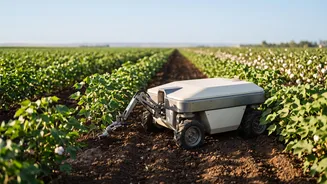
This is where Edge AI weeding robots are changing the game. These autonomous machines navigate the fields, using a combination of high-resolution cameras and artificial intelligence to do what was previously impossible at scale: identify and eliminate individual weeds without harming the crop. The 'Edge AI' part is crucial. It means the robot processes information and makes decisions directly on the machine itself ('at the edge') rather than sending data to a distant cloud server. This allows for real-time, split-second actions, which are essential when a robot is moving through a field and needs to distinguish a weed from a valuable cotton plant instantly.
How They See and Act
As a robot moves through a cotton field, its cameras scan the ground, feeding a constant stream of images to its onboard AI model. This AI has been trained on thousands of images to recognize the specific shapes and colours of common weeds versus cotton seedlings. When the AI identifies a weed, it triggers a precise action. Some robots use tiny, targeted micro-sprayers to apply a burst of an approved organic herbicide. Others use mechanical tools, like a tiny hoe or a high-powered laser, to physically destroy the weed. Because this action is so precise—targeting only the weed—it eliminates the risk of damaging the nearby cotton plant and uses minimal resources, perfectly aligning with the principles of organic farming.
The Payoff: Certification and Profitability
By deploying these robots, cotton farmers solve their biggest organic farming challenge. They can effectively manage weeds without using prohibited synthetic chemicals, a core requirement for certification. This keeps them in compliance during annual inspections and helps them maintain the detailed records required by certifying bodies. The economic benefits are just as significant. Robots can reduce the need for manual weeding labour by as much as 60-85%, a massive cost saving. While the initial investment in a robot can be substantial, the return on investment comes from reduced labour costs, the elimination of chemical expenses, and, most importantly, the ability to successfully produce a high-value, certified organic crop year after year. This technological leap makes organic cotton farming not just more sustainable, but also more profitable.