


A Landmark Discovery in Distant Skies
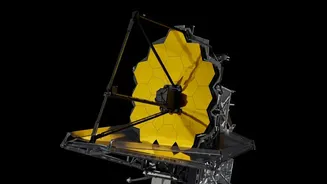
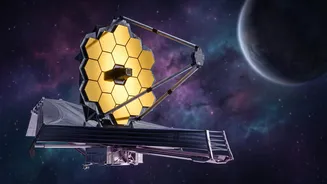
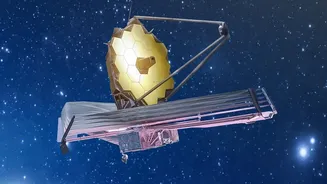
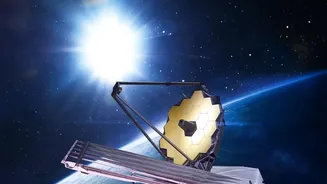
In a breakthrough for astronomy, scientists using the JWST have confirmed the chemical signature of water vapour in the atmosphere of a 'super-Earth' outside our solar system. While water has been detected on massive gas giants before, finding it on a rocky,
albeit large, planet marks a significant milestone. This discovery doesn't just add to our catalogue of alien worlds; it proves that a key ingredient for life, as we understand it, can exist on rocky planets orbiting other stars. The finding validates the incredible power of the telescope and the methods designed to probe these far-off environments, shifting the search for life from a theoretical exercise to an active investigation.
So, What Is a Super-Earth?
The term 'super-Earth' might sound like a bigger, better version of our own planet, but it's a technical classification based on size and mass. A super-Earth is a planet more massive than Earth but significantly lighter than our solar system's ice giants, Uranus and Neptune. They can be anywhere from two to ten times the mass of Earth. Interestingly, super-Earths are one of the most common types of planets discovered in our galaxy, yet our own solar system doesn't have one. This makes them a fascinating puzzle for scientists. They can be rocky worlds, gas-shrouded 'mini-Neptunes', or even ocean planets, and understanding their nature is a top priority for astronomers.
How Webb 'Sees' an Alien Atmosphere
The James Webb Space Telescope doesn't see water in the way you might see steam from a kettle. Instead, it uses a brilliant technique called transit spectroscopy. As an exoplanet passes in front of its host star from our perspective, a tiny amount of starlight filters through the planet's atmosphere. The powerful infrared instruments on board the JWST, called spectrographs, can 'read' this light. Every chemical and molecule, including water (H2O), absorbs light at a unique set of wavelengths. This creates a chemical 'barcode' in the light that reaches the telescope. By analyzing which wavelengths of light are missing, astronomers can determine precisely what gases make up that planet's atmosphere, even from light-years away.
Water, But Not Necessarily Life
It's crucial to put this discovery into perspective. The presence of water vapour does not automatically mean we've found a habitable world, let alone life. Many super-Earths orbit extremely close to their stars, resulting in scorching surface temperatures that would make liquid water impossible. For example, previous observations of the rocky planet GJ 486 b showed hints of water, but its surface is a blistering 430 degrees Celsius. The true significance of this recent finding is the technological proof-of-concept. It demonstrates that the JWST can successfully detect this vital molecule on a rocky world. This capability is the foundation for the next stage of exploration: surveying planets within the 'habitable zone'—the orbital sweet spot where temperatures could allow liquid water to exist on a planet's surface.