


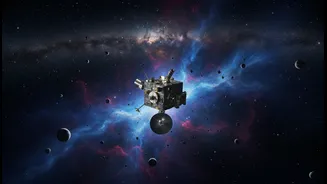


A Long-Distance Slumber
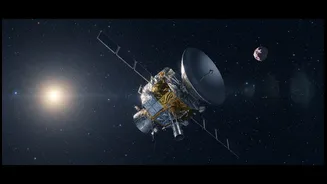
On July 7, 2026, NASA confirmed that the New Horizons spacecraft had successfully emerged from a 321-day hibernation period. Flight controllers at the Johns Hopkins Applied Physics Laboratory (APL) sent commands in July of the previous year, programming
the probe to awaken on its own. Due to its immense distance—roughly 9.5 billion kilometres away—the confirmation signal took nearly nine hours to travel back to Earth. This practice of putting the spacecraft into a low-power state is crucial for deep space missions. It conserves energy, reduces wear on its systems, and lowers operational costs during the long cruise phases between major scientific objectives. While most systems were powered down, several key instruments continued to gather data, essentially making New Horizons a silent observer in the cosmic dark.
A Historic Journey So Far
New Horizons has already secured its place in the annals of space exploration. Launched in 2006, it is the fastest human-made object ever launched from Earth. Its primary mission was the first-ever flyby of Pluto, which it accomplished in spectacular fashion in July 2015. The data it sent back transformed our view of the dwarf planet from a distant, fuzzy point of light into a complex world with ice mountains, vast nitrogen glaciers, and a thin atmosphere. But its mission didn't end there. In 2019, the probe made history again by visiting Arrokoth, a snowman-shaped object in the Kuiper Belt and the most distant object ever explored up close by a spacecraft. This encounter provided an unprecedented look at a planetesimal, one of the primitive building blocks of planets.
The New Mission: Charting the Kuiper Belt
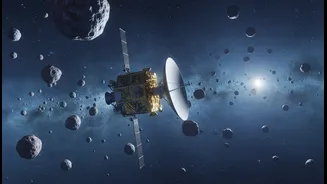
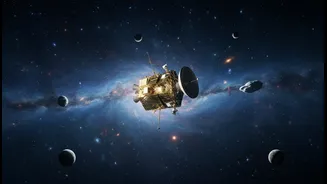
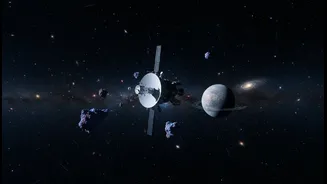
Now awake and fully operational, New Horizons is embarking on a different kind of mission. It is no longer heading for a specific flyby target but is instead acting as a remote observatory travelling through the Kuiper Belt. This donut-shaped ring of icy bodies beyond Neptune is often called the 'third zone' of our solar system, a vast, cold region populated by ancient remnants from the solar system's formation. The spacecraft will now begin downlinking the health data and scientific observations it collected while hibernating. Its instruments, including the Solar Wind Around Pluto (SWAP) and a student-built dust counter, have been continuously measuring the particle and dust environment. In the coming weeks, its ultraviolet spectrograph will begin observing the distribution of hydrogen gas at the far reaches of the sun's influence, known as the heliosphere.
Why This Continued Exploration Matters
The data New Horizons gathers is more than just a travelogue from a distant place. It provides a unique, direct measurement of conditions in a part of the solar system no other active mission is exploring. By studying the dust, plasma, and gas in the Kuiper Belt, scientists can piece together the story of how our solar system was born. Each particle measurement helps refine our models of planetary formation. Furthermore, the probe is travelling towards the edge of the heliosphere, the protective bubble of plasma created by the Sun's solar wind. Only the Voyager 1 and 2 probes have crossed this boundary into interstellar space. New Horizons will provide modern data on this mysterious frontier, with scientists estimating it could cross the boundary as early as 2029.