




A Library Made of Ice
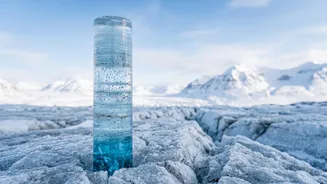
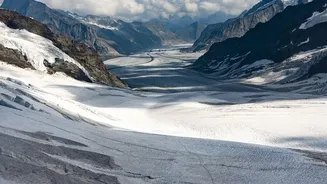
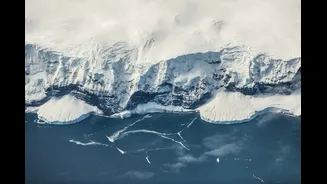
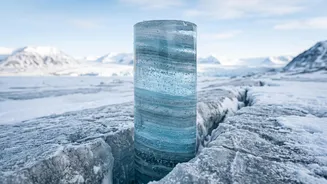
Imagine a library where each book is a layer of snow that fell hundreds of thousands of years ago. This is essentially what an ice core is. Scientists drill deep into ice sheets, some over three kilometres thick, to extract long cylinders of ice. Each
year, snowfall adds a new layer, which gets compressed by the snow above it. Over millennia, this process creates a continuous, layered timeline of ice, with the oldest sections at the very bottom. The longest ice cores retrieved from Antarctica provide an unbroken climate record stretching back an astonishing 800,000 years.
Bubbles of Ancient Atmosphere
The true magic of ice cores lies in what's trapped within them: tiny bubbles of air. As snow turns to ice, it captures small pockets of the surrounding atmosphere. These bubbles are not just empty spaces; they are pristine samples of what the air was like at the moment the ice formed. By carefully melting or crushing sections of the core in a vacuum, scientists can release and analyze this ancient air. Using sophisticated instruments like mass spectrometers, they can directly measure the concentrations of greenhouse gases, such as carbon dioxide (CO2) and methane, that were present in the atmosphere hundreds of thousands of years ago.
The Pace of Natural Change
The ice core record shows a clear and repeating pattern. Over the last 800,000 years, Earth has cycled through ice ages and warmer interglacial periods. During cold glacial periods, CO2 levels were naturally low, around 180 parts per million (ppm). During warmer periods, they rose to about 280-300 ppm. What's crucial, however, is the speed of these changes. Data from the end of the last ice age, around 12,000 years ago, shows that even the most rapid natural increases were slow by today's standards. A significant natural rise of around 20 ppm took about 1,000 years to occur.
An Unprecedented Modern Spike
This historical data provides a vital yardstick to measure our current situation. For centuries before the Industrial Revolution, CO2 levels were stable at around 280 ppm. Since then, human activities like burning fossil fuels have caused a dramatic and rapid spike. Today, atmospheric CO2 concentrations have soared past 420 ppm, a level not seen in at least 800,000 years. The speed of this increase is what truly stands out. While it took nature 1,000 years to raise CO2 by 20 ppm at the end of the last ice age, humanity has caused a similar increase in just the last 10 years. Some analyses suggest the current rate of CO2 increase is more than 250 times faster than it was from natural sources after the last Ice Age.